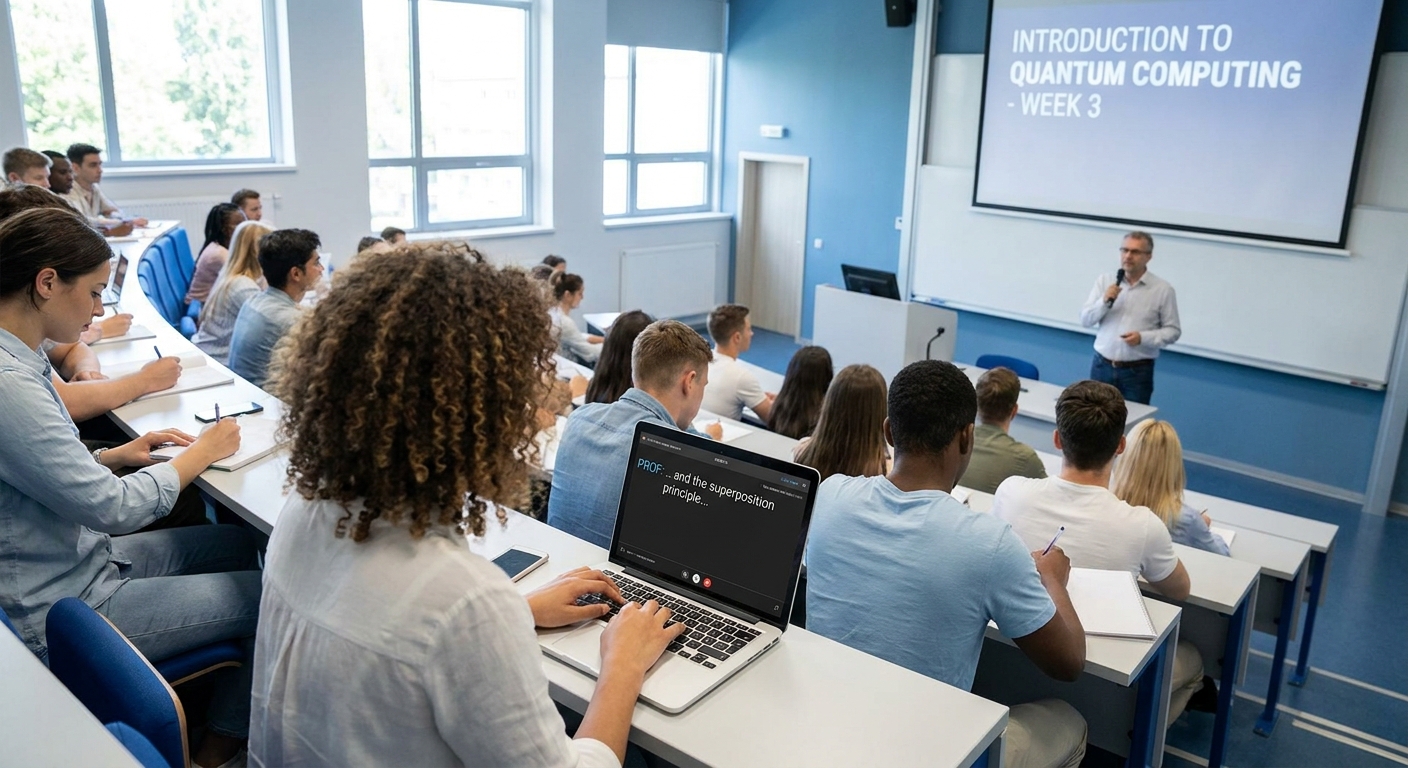
Universities have long understood that not all students experience a lecture the same way. A student with a hearing impairment catches fragments. A student whose first language is not the language of instruction may follow the argument but miss key terminology. A student managing a chronic health condition who attended but was cognitively fatigued retains less than a peer who sat through the same ninety minutes in full health. None of these students are less capable; all of them are being asked to learn from a format that was designed without them in mind.
Lecture transcription is one of the few interventions that addresses all of these gaps simultaneously — and that benefits the broader student population in ways that are often underestimated. This article examines the practical case for lecture transcription across four dimensions: legal and ethical accessibility obligations, support for multilingual learners, revision and retention, and the long-term value of a searchable institutional course record.
Accessibility as a Baseline, Not an Add-On
In most jurisdictions, universities carry legal obligations to provide reasonable accommodations to students with disabilities. For students who are deaf or hard of hearing, this obligation typically involves providing access to audio content in text form. Historically, this meant hiring a note-taker or a Communication Access Realtime Translation (CART) provider — a human stenographer who produces live captions during a lecture. These services are effective but expensive and logistically demanding: they require advance scheduling, are difficult to scale across an entire institution, and depend on the availability of qualified practitioners.
Automated transcription changes the economics of this provision significantly. A post-lecture transcript delivered within hours of the session is not an identical replacement for live CART — the student cannot follow in real time — but it addresses the core access gap: the student has an accurate text record of what was said, against which they can study, review, and self-assess. For recorded lectures in asynchronous or hybrid courses, the gap between live CART and post-lecture transcription disappears entirely.
The accessibility argument extends beyond formal disability accommodations. Temporary impairments — a student recovering from ear surgery, a student with a short-term cognitive processing difficulty following illness — are not typically covered by formal accommodation plans but create the same access gap. Transcripts serve these students without requiring formal disclosure or the administrative burden of establishing a documented accommodation.
There is also a growing recognition that accessibility design benefits everyone. Captions, originally developed for deaf viewers, are now used by the majority of video viewers regardless of hearing status — in noisy environments, in libraries, for non-native speakers, for viewers who process text faster than speech. The same dynamic applies to lecture transcripts. Designing for the edge case produces a resource that the majority finds useful.
Multilingual Learners and the Comprehension Gap
International student enrolment has grown substantially at universities across Europe, North America, and Australia over the past two decades. These students — many of whom passed rigorous language proficiency tests to gain admission — frequently report a specific comprehension difficulty in lecture settings that they do not experience in one-to-one conversation or written text: the speed of delivery, combined with technical vocabulary, disciplinary jargon, and varied accent, creates a cognitive load that leaves gaps in their understanding even when their language proficiency is high.
This is not a failure of language skill; it is a feature of live speech. Native speakers of the instruction language make the same errors, miss the same phrases, and compensate the same way — by asking colleagues, reviewing slides, and filling gaps from memory. International students often cannot compensate in the same way: their peer networks may be smaller, they may be less confident asking lecturers for clarification in a second language, and they may not have enough surrounding context to reliably fill gaps from memory.
A transcript provides the missing scaffolding. The student who understood eighty percent of a lecture in the room can review the transcript and close the gap to near-complete comprehension. Technical terms that flew past in speech can be looked up in context. Sentences that were unclear when heard at speed become clear when read. The transcript does not replace the experience of being in the lecture; it converts an incomplete understanding into a complete one.
This effect compounds across a degree programme. A student who leaves each lecture with near-complete comprehension builds on a solid foundation. A student who consistently leaves with gaps — even small ones — accumulates conceptual deficits that become increasingly difficult to repair as courses build on earlier material. Transcript access is not a luxury provision for international students; it is an equity measure that directly affects academic outcomes.
Revision, Retention, and the Limits of Notes
The standard model of lecture learning assumes that students take effective notes in real time and review those notes when revising for assessments. There are well-documented problems with this model. Note-taking while listening is a dual-task activity that degrades performance on both tasks simultaneously: students who are writing cannot attend fully to what is being said, and students attending fully to what is being said cannot write complete notes. The compromise most students reach — partial notes, key terms, rough outlines — is adequate for triggering recall during revision but inadequate as a standalone learning resource.
Research on lecture note quality consistently finds that student notes contain between twenty and forty percent of the key points from a lecture. The gap is not uniformly distributed: students capture the points that are repeated, slowed down, or written on slides, and miss the connecting logic, the qualifying statements, and the examples used to illustrate abstract principles. These omissions matter because exam questions frequently probe exactly the material that is harder to capture in notes — nuanced argument, methodological caveats, applied reasoning.
A full-text transcript fills this gap precisely. The student revising from a transcript can locate specific examples, re-read the exact formulation of a principle, and follow the logical sequence of an argument without having to reconstruct it from abbreviated notes. For courses where the lecture is the primary means of delivering content — rather than a supplement to a textbook — this is a substantial advantage.
Transcripts also enable active revision strategies that notes alone do not support. Students can annotate a transcript, highlight key passages, compare the lecturer's formulation of a concept against the textbook version, or run text searches to locate all instances where a specific term was used across multiple lectures. These are qualitatively different study behaviours from re-reading lecture notes, and they correlate with stronger retention and deeper understanding.
The Searchable Course Archive
The value of lecture transcripts does not end with the students who were in the room. A full-semester transcript archive creates a searchable institutional record of course content that has uses beyond individual revision.
For students who miss a lecture — due to illness, family emergency, or timetable conflict — a transcript provides a reliable record of what was covered. This is more informative than a peer's notes and more granular than slides, which typically capture headings and key points rather than the explanatory content that makes those points meaningful.
For lecturers, a transcript archive provides a resource for course development. Reviewing transcripts of previous deliveries allows a lecturer to identify where explanations worked, where students consistently asked questions at the same point (suggesting that the explanation was unclear), and how coverage of a topic evolved across semesters. This is a different kind of course reflection than student evaluation surveys, which aggregate perception rather than recording what was actually said.
For departments and institutions, transcript archives support curriculum mapping — the process of documenting what is taught, when, at what depth, and in what relationship to other courses. This process is typically done from syllabi and learning outcomes, which describe intended coverage rather than actual delivery. Transcripts bridge the gap between what was planned and what was taught.
There is also a knowledge-preservation argument. Faculty retire, move institutions, or are replaced. The intellectual content of a course — the particular framing of a discipline's foundational debates, the examples developed over years of teaching — is rarely documented anywhere that outlasts the individual. A transcript archive preserves this content in a form that can inform successor courses and support institutional memory.
Privacy, Consent, and Responsible Implementation
Lecture transcription raises legitimate questions about privacy and consent that institutions need to address explicitly rather than sidestep.
Lecturers have a reasonable interest in how their spoken words are recorded and used. A transcript of an off-the-cuff explanation that was later reconsidered, or a comment made in the context of discussion that was never intended as a formal statement, can be stripped of context in ways that the lecturer did not anticipate. Academic freedom arguments intersect here: the informality of live lecture delivery is partly what makes it pedagogically effective, and a surveillance-like awareness that every word is being transcribed may inhibit that informality.
These concerns are real and should shape implementation policy. Reasonable approaches include: notifying students and lecturers that transcription is occurring; providing lecturers with access to their own transcripts and the ability to flag or correct errors; limiting transcript access to enrolled students rather than making them publicly available; and establishing clear retention policies so that transcripts are not held indefinitely beyond their academic purpose.
Student speech in lectures — during Q&A, discussion sessions, or seminar contributions — raises additional consent questions. A student who asks a question during a lecture has not necessarily consented to having that question preserved in a searchable text record. Transcription policies should address whether student contributions are included, and if so, how they are labelled and who can access them.
None of these concerns are reasons to avoid transcription; they are reasons to implement it with care. Most students and lecturers, when consulted, support transcription when privacy concerns are addressed and when the access benefits are clearly explained.
Implementation Without Disruption
The practical barriers to lecture transcription have fallen substantially. Automatic transcription services can process an audio recording and return a first-pass transcript in minutes. The remaining human effort — reviewing for accuracy, correcting proper nouns and technical terminology, formatting for readability — typically takes thirty to sixty minutes for a ninety-minute lecture, with accuracy improving as the system learns recurring vocabulary.
Most learning management systems can host transcripts alongside slides and recordings, making them accessible to enrolled students without requiring a separate platform. Some institutions integrate live captioning directly into lecture capture systems, producing the transcript as the recording is made rather than as a post-processing step.
For institutions looking to implement systematically, a phased approach reduces resistance: beginning with courses that already use lecture capture, working with faculty who are already engaged with accessibility issues, and publishing results that demonstrate the equity and academic benefits for the broader student population.
The Core Argument
Lectures are the primary means by which universities deliver education. They are also a format with well-documented inequities: they advantage students with strong working memory, fluency in the language of instruction, and the ability to sustain focused attention across an extended session. These are not measures of academic ability, but they correlate strongly with performance in lecture-dependent assessments.
Transcription does not eliminate these inequities, but it substantially reduces them. It gives students a second pass at content they did not fully catch the first time. It makes the course record accessible to students who experience access barriers that are invisible to instructors. It creates a resource that improves revision, supports knowledge retention, and extends the life of course content beyond the room in which it was delivered.
For institutions that take equity seriously, lecture transcription is not an accommodation for the few. It is infrastructure for the many.