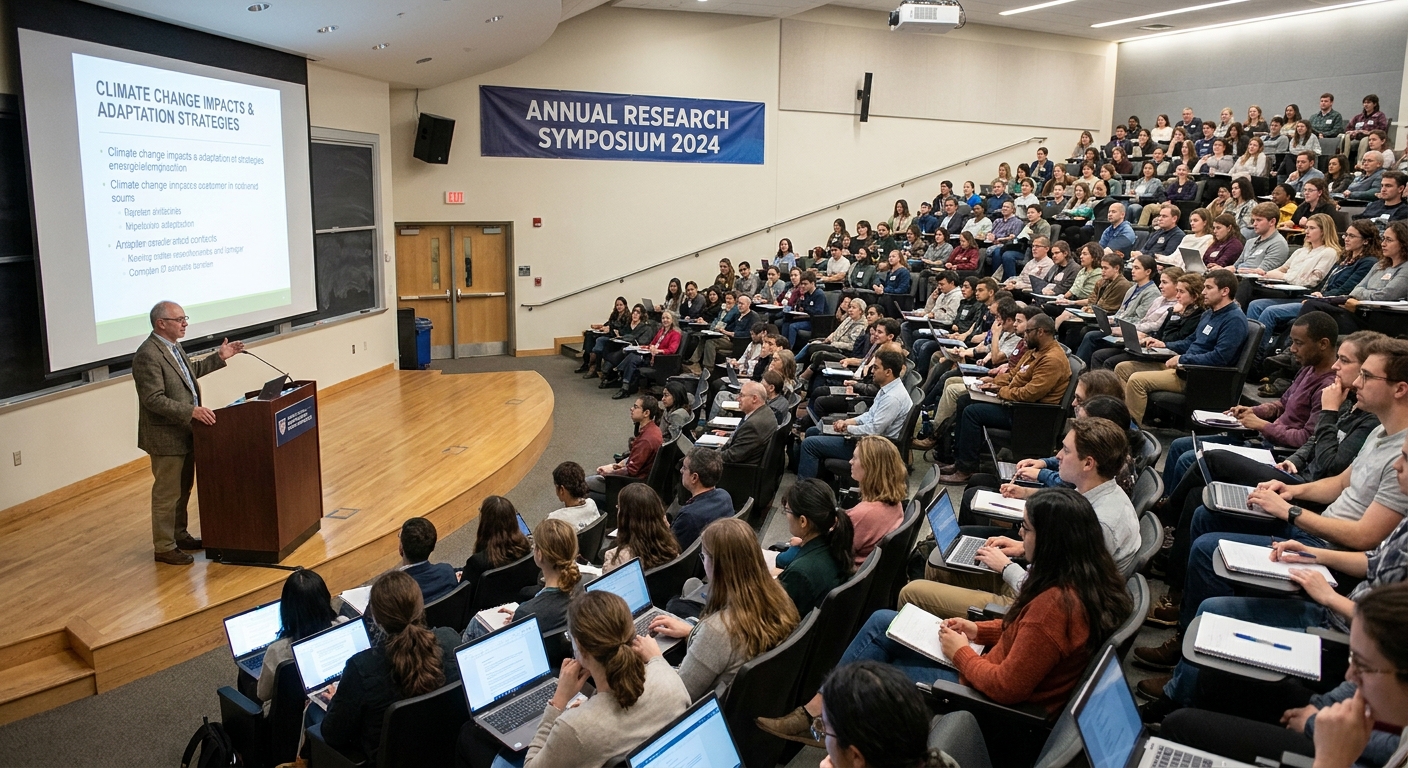
The academic conference is a peculiar institution. Researchers spend months preparing papers, travel hundreds or thousands of miles, and gather in the same room for three or four days — yet the most consequential exchanges often happen not in the sessions themselves but in the Q&A periods, the corridor conversations, and the working group discussions that fill the margins of the programme. The formal outputs — the proceedings volume, the slide decks, the archived recordings — rarely capture what was actually said, and almost never capture the back-and-forth that gives a presentation its intellectual life.
This is the knowledge problem that conference transcription addresses. A recorded presentation contains the paper. A transcript of the full session, including the Q&A, contains the conference.
The Parallel Sessions Problem
Most conferences above a certain size run concurrent sessions. A researcher attending a three-day conference with four parallel tracks faces a structural information problem: at any given slot, three of the four sessions are inaccessible. They can consult the proceedings later for the papers themselves, but the Q&A, the live discussion, and the responses that a presenter gave to unanticipated questions are simply lost.
Conference organisers have long recognised this problem and responded with various measures — video recording, live streaming, social media summaries — but each of these solutions is partial. A video recording requires a viewer to watch in real time or scrub through footage to locate a specific exchange. A live tweet thread captures fragments in a format that degrades rapidly as the conference recedes. A summary captures the reporter's interpretation of what was said, not what was actually said.
A searchable transcript changes the situation entirely. A researcher who could not attend a parallel session can locate, within a transcript, the specific question about measurement validity that the presenter addressed at the forty-minute mark — not the presenter's general position on the topic, but the precise response they gave to a specific challenge. That precision is not a luxury; it is often the difference between understanding a researcher's actual position and misrepresenting it in a subsequent paper.
What Q&A Produces That Papers Do Not
The formal academic paper is a finished product. By the time it appears in a proceedings volume or a journal, it has been revised, reviewed, and polished into a form that presents a position rather than working through one. The Q&A session at a conference is the inverse: it is the space where a methodology gets challenged, where a finding is complicated by an audience member's countervailing data, where a theoretical framework gets pushed toward its edges.
These exchanges are substantively different from the paper they follow. A presenter who has written a clean argument in their paper may, in response to a sharp question, acknowledge a limitation they did not address in the text, offer a qualification that significantly changes how the finding should be interpreted, or point toward future work that the paper does not mention. None of this appears in the proceedings. All of it is relevant to anyone working in the same area.
The Q&A is also where questions get asked that papers typically do not answer: questions about the practical implications of a finding for a specific policy context, questions about whether a method has been applied in a domain outside the paper's scope, questions about how the presenter reconciles their argument with a conflicting finding in the literature. A researcher in the audience who asks one of these questions and receives a substantive answer has gained something that is not available anywhere in print.
When those exchanges are transcribed, they become citable, searchable, and shareable. When they are not transcribed, they are available only to those who happened to be in the room — and increasingly, as hybrid and online conference formats expand, many registered participants are not in the room at all.
Hallway Discussions and the Informal Record
The academic cliche about hallway conversations being more valuable than the sessions themselves has a basis in fact. Conversations between sessions — at coffee breaks, at poster sessions, over lunch — are where researchers discover shared problems, propose collaborations, and receive the kind of frank peer feedback that formal review processes rarely provide. A researcher presenting work in progress may learn more from a five-minute corridor conversation with a senior colleague than from the official Q&A.
These conversations are not systematically transcribable in the way formal sessions are. But some conference formats — working groups, roundtable discussions, structured networking sessions — do take place in settings where recording and transcription is practical and where participants consent to capture. Transcribing these sessions, rather than relying on the inevitable incomplete notes that participants produce in the moment, creates a record that reflects what was actually discussed rather than what individual participants happened to write down.
For small-group workshop formats in particular — where the entire point is the discussion rather than a set of formal presentations — transcription is often the most faithful record available. A workshop on emerging methodological debates in a subfield may produce no papers and no proceedings, but a transcript preserves the actual state of the debate among practitioners who were present.
Conference Archives and Institutional Memory
Academic societies and conference organisers face a long-term problem: the knowledge generated at their events disappears almost entirely within weeks of the conference closing. The proceedings capture the papers. Everything else — the discussions, the debates, the responses to emerging challenges in the field — is lost to institutional memory unless it is actively captured.
This is a significant loss for disciplines where conference presentations represent cutting-edge work that may not reach journals for two or three years. In fast-moving fields, what was said at a conference three years ago may be as relevant to current debates as anything in current journals — but only if it was recorded in a form that allows retrieval.
A systematic programme of session transcription allows a learned society to build an archive that reflects the intellectual history of the field as it was actually discussed, not merely as it was formally published. This has value for current researchers seeking to understand the development of a debate, for historians of science working on more recent periods, and for the discipline itself in understanding how its ideas evolved through the conference circuit before reaching print.
Transcription also enables practical post-conference work: producing accurate minutes for business sessions, generating accessible summaries for members who could not attend, and creating searchable records that allow conference organisers to track recurring themes across multiple years of programming.
Accessibility for Presenters Reviewing Their Own Talks
Presenters benefit from transcripts of their own sessions in ways that are often underappreciated. Most researchers, having just delivered a presentation, have an imperfect memory of what they actually said — especially in the Q&A, where responses are improvised rather than prepared. The questions that were asked, and the specific answers given, may be difficult to reconstruct accurately within days, and impossible to reconstruct accurately within months.
A transcript allows a presenter to review their own arguments with the same detachment they would bring to reading a colleague's paper. They can identify where their explanation was unclear, note the specific phrasing that a questioner found ambiguous, and revise their account of a finding in light of the feedback they received. For work in progress — where the conference presentation is a stage in a longer research arc, not the final output — this kind of systematic self-review is methodologically valuable in ways that vague post-conference recollections are not.
Presenters who plan to develop a conference paper into a journal submission particularly benefit from transcripts of the Q&A. The questions an audience asked identify the gaps, ambiguities, and challenges that peer reviewers are likely to raise. Working through those questions on the basis of an accurate transcript is more productive than reconstructing them from memory, and substantially more productive than having no record at all.
Capturing Feedback on Work in Progress
Many conference formats explicitly invite work-in-progress presentations — paper development sessions, early-career researcher workshops, dissertation prospectus defences, grant proposal presentations. In these contexts, the presenter is not defending a finished argument but seeking feedback on one that is still forming. The feedback they receive is, in a direct sense, an input into the research itself.
Accurate capture of that feedback matters in ways it does not for a polished keynote. A keynote presenter who misremembers a question loses an interesting observation. A doctoral student who misremembers the methodological challenge their committee member raised at a paper development session may carry a misunderstanding into their dissertation that a transcript would have prevented.
Work-in-progress sessions also often include structured feedback formats — assigned discussants, formal commentary periods, small-group breakout discussions — where the feedback is both more systematic and more valuable than informal Q&A. Transcribing these sessions gives presenters a complete record of the feedback they received, and gives organisers documentation of the kind of mentorship and developmental activity the conference provides — which is increasingly relevant to funders and accrediting bodies who want evidence of training and professional development activities.
Technical Terminology and Multiple Speakers
Academic conference transcription presents specific technical challenges that general-purpose transcription services handle inconsistently. Field-specific terminology — including proper nouns for theories, methods, datasets, and researchers — appears without the surrounding context that would help a generic system resolve ambiguity. Statistical terms, mathematical notation read aloud, and references to specific datasets by abbreviation all create transcription challenges that are routine in an academic context and unusual in a business one.
Multiple-speaker dynamics in Q&A sessions add further complexity. Questions from the floor are often asked from a distance from any microphone, creating audio quality challenges. Audience members may ask follow-up questions while a presenter is still responding. Discussions between two audience members, or between a presenter and a discussant, may involve rapid turn-taking that requires accurate speaker identification to follow.
Conference recordings made in large rooms with audience microphones or handheld roving mics typically have variable audio quality across the session. Transcription systems that handle variable audio quality, multiple speakers, and domain-specific vocabulary reliably are substantially more useful for academic conference work than systems optimised for controlled studio or video call environments.
Hybrid and Online Conference Formats
The growth of hybrid and fully online conference formats since 2020 has both expanded the potential audience for conference sessions and increased the importance of transcription as an accessibility tool. A hybrid conference where some participants attend in person and others join remotely creates a persistent inequality: remote participants, even when technically able to attend in real time, have less access to the informal content of the conference — the hallway conversations, the side exchanges during breaks, the post-session discussions that continue at the coffee station.
Transcription does not solve the inequality of hybrid formats, but it reduces it for the formal content of sessions. A remote participant who missed a parallel session because of a time zone conflict, or who was unable to attend at all, can work through a session transcript in a way that is substantially more efficient than watching a recording. The transcript is searchable, can be read at variable speed, and can be excerpted without requiring the reviewer to watch surrounding material.
For online-only events, where recordings are routinely produced as a matter of course, transcription converts an existing asset — the video recording — into a more accessible and more searchable form at modest additional cost. The case for transcribing recorded online sessions is among the most straightforward in academic knowledge management.
Practical Considerations for Conference Organisers
Conferences considering a transcription programme face a small number of practical decisions. Consent is the first: participants should know before they speak that sessions are being transcribed, and the consent framework should be explicit about whether transcripts will be archived, published, or shared with participants only. Most conference participants will consent readily, but the process should be designed rather than assumed.
Coverage decisions matter too. Transcribing every session of a large conference is feasible but requires planning. A more targeted approach — transcribing keynotes and plenary sessions universally, and offering individual session transcription on request or for sessions that are recorded — allows organisers to deliver immediate value without committing to comprehensive coverage before the logistics are established.
Turnaround expectations should be set in advance. Post-conference transcripts are most valuable when they are available within days of the conference close, while participants can still use them to supplement their notes and inform follow-up correspondence. A transcript delivered three months after the conference has most of the archival value but little of the immediate use value.
XMOX transcribes academic conference presentations and Q&A sessions accurately, handling technical terminology and multiple speakers. Try it free on your next conference recording. Get started free