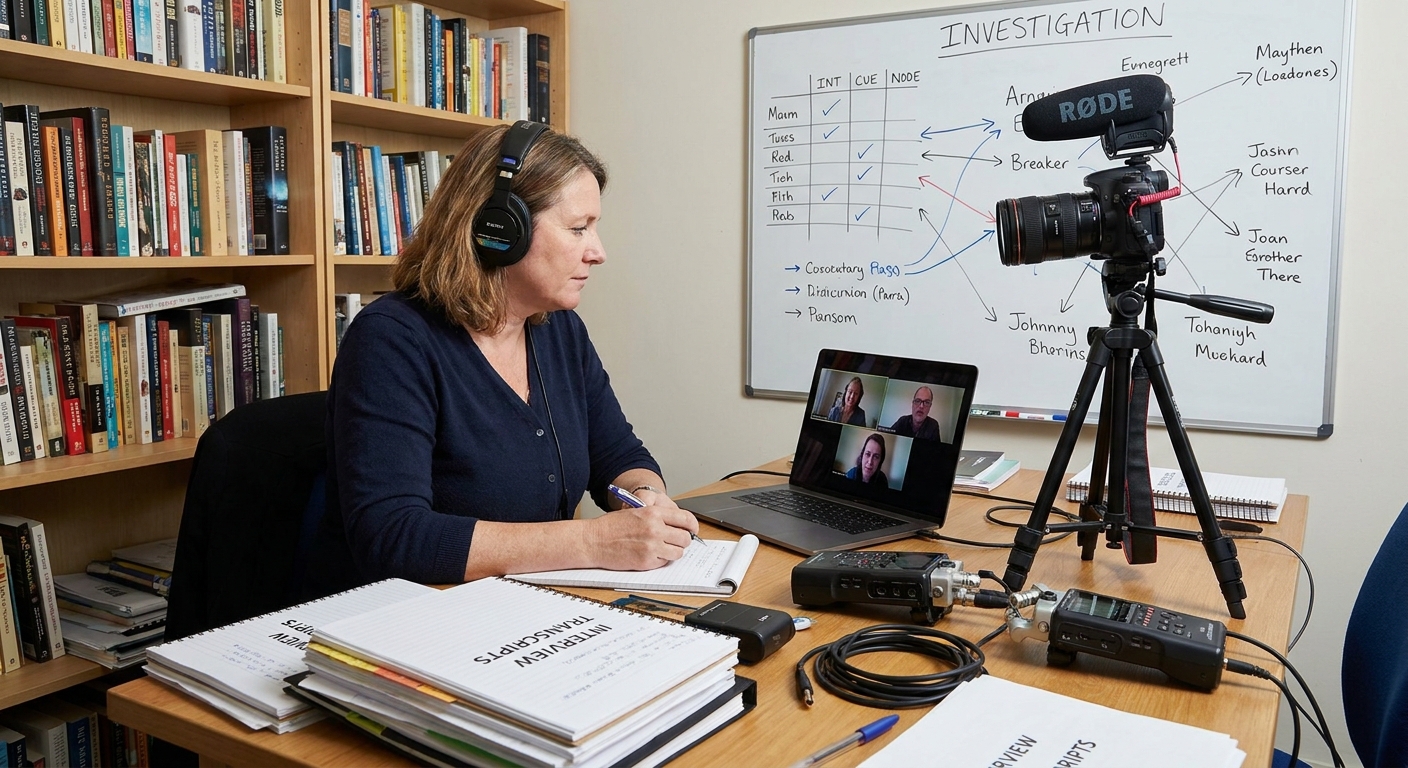
A feature documentary is not built from a single conversation. It is built from dozens — sometimes hundreds — of interviews conducted across months or years, with subjects who contradict each other, remember events differently, and speak with accents, dialects, and registers that an automated transcription system must navigate without prompting. Before the director assembles the first rough cut, a documentary researcher has typically spent weeks doing something that looks less like filmmaking and more like archival scholarship: reading, annotating, cross-referencing, and distilling hours of recorded speech into a usable body of evidence.
This is the part of documentary production that receives the least public attention and creates the most practical difficulty. Managing multi-source interview transcripts is a distinct professional discipline, and the tools and habits a researcher brings to it determine how efficiently the entire production moves from footage to finished film.
The Scale Problem
A standard documentary production might generate between forty and two hundred hours of recorded interview material. Even at the conservative end of that range, forty hours of audio represents a substantial commitment of time if each hour must be reviewed by ear. A researcher working at normal listening speed would spend a full working week on that material before writing a single note. At two hundred hours, the arithmetic becomes prohibitive.
Transcription changes the arithmetic. A full-text transcript of a two-hour interview can be read in twenty minutes, searched in seconds, and annotated without touching the original audio file. For a researcher managing thirty or forty subject interviews, the difference between working from transcripts and working from recordings is roughly the difference between a manageable project and an unmanageable one.
The scale problem is compounded by the multi-speaker reality of documentary work. Unlike a single journalist interviewing a single source, a documentary production typically involves an interviewer, the primary subject, and sometimes other voices in the room — translators, family members, background speakers. A transcript that accurately attributes each voice to the correct speaker is a fundamentally different research tool from one that presents the conversation as an undifferentiated block of text.
Conflicting Sources and the Research Function
Documentary subjects frequently contradict each other. Two witnesses to the same event will give different accounts of when it happened, who was present, and what was said. A defendant and a victim may describe the same interaction in ways that are not merely different in emphasis but mutually exclusive in fact. The researcher's job is not to resolve these conflicts but to map them — to produce a clear account of who said what, where the accounts diverge, and what the divergence implies for the narrative the director is trying to construct.
This mapping work requires the transcript as a primary document. A researcher who has only listened to the interviews must hold the contradictions in memory, or in shorthand notes that inevitably compress and distort. A researcher working from full transcripts can place two accounts side by side, identify the exact words each subject used to describe the same event, and note the precise points at which the accounts diverge. That precision matters when a director is deciding which version to include, which to contextualise, and which to let stand against each other in the final cut.
It also matters for the production's legal exposure. A documentary that presents factual claims about real people and real events is a document with legal implications. The research file — including the original transcripts — is part of the evidentiary basis for those claims. Researchers who maintain clean, complete transcripts are researchers who can demonstrate where every factual assertion in the film originated.
Finding the Narrative Thread
Documentary research is fundamentally a process of synthesis. Sixty interviews produce sixty individual accounts. The researcher's task is to find the through-line that connects them — the recurring theme, the contradictory claim that appears in multiple accounts, the single sentence spoken by a secondary subject that reframes everything the primary subjects have said.
This kind of synthesis is only possible with searchable text. A researcher who wants to know how many subjects mentioned a specific date, a specific location, or a specific name cannot answer that question by listening to sixty recordings. They can answer it in minutes by running a search across sixty transcripts. The ability to locate every instance in which a particular topic arises across the entire interview corpus — without re-listening to a single recording — is the primary analytical advantage that full transcription provides.
Experienced documentary researchers often work with what might be called a "paper cut" before the editor ever touches the footage. A paper cut is a document that assembles potential soundbites from across the transcripts into a provisional narrative structure — essentially a draft of the film written in quotes. Building a paper cut from transcripts is straightforward; building one from memory and partial notes is the kind of work that requires extraordinary recall or produces an incomplete picture of what the material actually contains.
The Researcher's Role Versus the Director's Role
In most documentary productions, the researcher and the director have distinct relationships with the interview material. The researcher engages with all of it; the director, in the early stages, engages with summaries, highlights, and recommendations. This division of labour is practical — directors are making creative decisions across the entire production simultaneously and cannot spend weeks in the archive — but it creates a communication challenge.
The transcript is the primary medium through which that communication happens. A researcher who delivers a set of annotated transcripts, with key passages highlighted and thematic connections noted in the margins, is giving a director a navigable map of the material. A researcher who delivers only summary notes is giving a director their interpretation of the material — which may be accurate, but which forecloses the director's ability to discover something the researcher missed or weighted differently.
This distinction becomes acute in the edit. When a director and editor are assembling a cut and need a specific type of quote — a moment of doubt, a factual concession, an emotional shift — they need to be able to locate it quickly across all available material. A searchable transcript archive, organised by subject and cross-referenced by theme, is the infrastructure that makes that possible. Without it, the edit depends on what the researcher remembers, which is an unreliable foundation for a production that may have been in progress for two years.
Organising Transcripts for Edit Decisions
The practical organisation of documentary transcripts varies by production, but several principles are consistent across professional practice. First, each interview should have its own complete, speaker-attributed transcript stored alongside its corresponding media file. Second, the transcript should be marked with timecodes at regular intervals — typically every thirty seconds to one minute — so that a quote identified in the text can be located in the footage without manual searching. Third, key passages should be flagged in a consistent system that the entire production team can read and use.
Beyond these basics, many researchers maintain a separate master document that aggregates key quotes by theme across all interviews. This thematic index does not replace the individual transcripts but complements them: it allows a director to see, at a glance, everything on a particular subject that any interviewee said, and then to go to the full transcript for context.
The timecode link between text and footage is particularly important at the later stages of production, when specific soundbites are being selected for inclusion. An editor pulling a clip needs to know exactly where in the original recording a quote begins and ends. A transcript without accurate timecodes — or with timecodes that drift because the transcription software lost sync — forces the editor back to manual audio review, which defeats the efficiency purpose of having a transcript at all.
Archiving for Distribution Compliance and E&O Insurance
Documentary films released through broadcast networks, streaming platforms, or theatrical distribution are subject to Errors and Omissions insurance requirements. E&O insurance protects distributors and producers against claims arising from the content of the film — including claims that statements made in the film are false, defamatory, or made without adequate research basis.
Underwriters reviewing an E&O application for a documentary will typically ask for evidence that factual claims in the film are supported by the research record. This is where the transcript archive becomes a compliance document as well as a research tool. A production that can produce complete transcripts of every interview, with clear attribution of every factual claim to a named source, is in a materially stronger position when applying for E&O coverage than one that can produce only audio recordings and researcher notes.
Distribution agreements — particularly with broadcasters in regulated markets — may also impose obligations to retain underlying research material for a specified period after broadcast. Some rights reversion clauses, international co-production agreements, and archival licensing deals include similar requirements. The researcher who maintains a clean, complete transcript archive from the outset is building the compliance infrastructure the production will need at the distribution stage, not scrambling to reconstruct it afterwards.
Practical Considerations for Multi-Speaker, Multi-Accent Material
Documentary interview material presents specific challenges for transcription that are less common in other contexts. Subjects speak in their natural registers — which may include regional accents, non-native English, technical terminology specific to the subject matter, or code-switching between languages. Interview conditions vary: some conversations take place in quiet studios, others in kitchens, fields, or vehicles, with ambient noise that degrades audio quality and reduces transcription accuracy.
A transcription tool used in documentary research needs to handle this variety reliably. Speaker diarisation — the ability to attribute each segment of speech to a distinct speaker label — is particularly important in interviews where an off-camera interviewer's questions are part of the recorded material. Accuracy on proper nouns, place names, and subject-specific vocabulary matters in a way it does not for general-purpose transcription, because those terms appear in the factual claims the research supports.
For material recorded in languages other than the primary production language, translation and transcription are typically handled separately, but the principle is the same: a written, readable, searchable record of what was said is the foundation on which all subsequent research work rests.
XMOX transcribes documentary interview footage accurately across multiple speakers and accents. Upload your interviews and start finding your story in the text.
Start free →