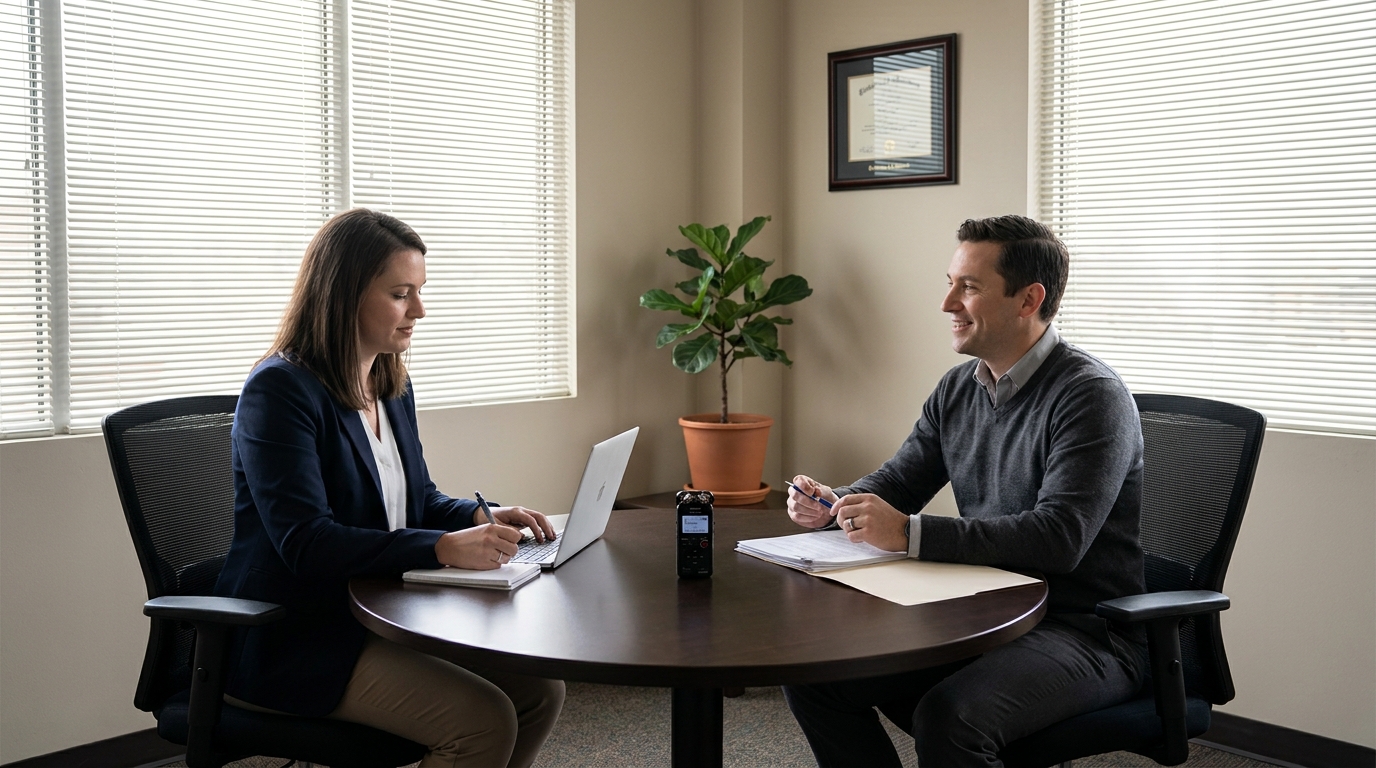
HR investigations and disciplinary meetings occupy a different category from most workplace conversations. What is said in these meetings can determine whether an employee keeps their job, whether a complaint is upheld, and whether the organisation can defend its decisions if the matter proceeds to an employment tribunal or litigation. The record of the meeting is not administrative housekeeping — it is, in many cases, the primary evidence on which the outcome rests.
And yet the documentation of these meetings is often produced under conditions that work against accuracy: a single note-taker trying to follow a charged conversation, notes written after the meeting from incomplete shorthand, and no mechanism for either party to verify what was recorded. When disputes arise — and in disciplinary matters, disputes often arise — the written record becomes the battleground.
Why HR Meeting Documentation Is Different
Most workplace documentation exists to record what was decided. HR investigation and disciplinary meeting records exist to record what was said — every significant statement, question, response, and piece of evidence presented. The distinction matters because employment law in most jurisdictions requires procedural fairness, and procedural fairness requires evidence. A record that says "the employee denied the allegation" is very different from a record that captures exactly what the employee said, in what terms, and in response to which specific question.
The legal standard for documentation in these contexts is higher than most HR practitioners realise. Employment tribunals and courts look at whether the process was fair, whether the decision-maker genuinely engaged with the employee's account, and whether the outcome was proportionate to the evidence. A thin, reconstructed record makes each of these questions harder to answer in the employer's favour. A detailed, contemporaneous record answers them directly.
The Four Failure Modes of Manual Investigation Notes
1. Selective capture. A note-taker in a disciplinary meeting is simultaneously listening to the conversation and deciding what is worth writing down. Under time pressure, the tendency is to capture conclusions and admissions and miss qualifications, context, and the employee's explanations. In a subsequent tribunal, those omissions become the substance of the employee's case: "I said X, but what I actually meant was Y, and the notes don't reflect that at all."
2. Paraphrase instead of verbatim. Notes that say "employee admitted to the behaviour" rather than recording what the employee actually said are routinely challenged. The employee's own characterisation of their words — "I said it was a mistake, not that I did it deliberately" — can directly contradict what notes framed as an admission. When the words matter, only the words will do.
3. Post-meeting reconstruction. Notes taken during a meeting are more reliable than notes written afterward. When notes are produced hours after the meeting — or, worse, after a draft outcome letter has been prepared — they are inevitably shaped by what the note-taker expected to write rather than what was actually said. Courts are alert to this. Contemporaneous notes carry more weight precisely because they are less susceptible to retrospective shaping.
4. Single-source risk. When the only record of a meeting is the employer's note-taker, and the employee disputes what the notes say, there is no mechanism for resolution. The dispute becomes one account against another, which is exactly the situation that fair process is supposed to avoid. Employees who feel their account has not been accurately captured often escalate — not necessarily because the decision was wrong, but because the process did not feel fair.
What Accurate Documentation Actually Requires
A record adequate for disciplinary or investigation purposes should capture several things that manual note-taking typically misses.
The sequence of the conversation. Who asked what, in what order, and how each party responded. Sequence matters for assessing whether the employee was given a genuine opportunity to respond to specific allegations before a decision was made.
The employee's exact words on material points. Where the employee's account of their own conduct or intentions is central to the outcome, the record should reflect their precise language, not the note-taker's summary of it.
Questions that were asked and those that were not. In some tribunal cases, the issue is not what the employee said but what they were not asked. A complete record demonstrates that the investigation was genuinely thorough.
The employee's demeanour and any non-verbal communication that is material. A transcript cannot capture body language, but a brief note alongside the transcribed text — "employee became distressed at this point" — provides the context that a bare text record misses.
Any corrections made during the meeting. If the employee corrected a summary, disagreed with how something was framed, or provided clarification, that correction should appear in the record alongside the original statement.
How Voice Transcription Changes the Process
The core problem with manual documentation of sensitive HR meetings is that the constraint on accuracy is structural: a human note-taker cannot follow a charged conversation at speed and produce a verbatim or near-verbatim record simultaneously. One or the other suffers. Voice transcription removes that constraint.
When a disciplinary or investigation meeting is transcribed — whether through a recording reviewed afterward or through a real-time transcription tool — several things change.
The note-taker becomes a reviewer. Instead of trying to capture everything in real time, the HR professional or note-taker can focus on the conversation and then review and annotate the transcript afterward. This produces a more complete record and allows the note-taker to engage more fully with what is being said.
The employee's words are captured precisely. For the specific points that matter most — the employee's account of their conduct, their response to particular allegations, their explanation of their intentions — the record reflects what they actually said, not a paraphrase. This protects both the employer, whose process is more defensible, and the employee, whose account is accurately preserved.
Post-meeting disputes become resolvable. When both parties know that a complete record exists, the scope for "that's not what I said" disputes narrows substantially. Employees who might otherwise feel that their account was not fairly captured are more likely to accept the process, even when the outcome goes against them.
Appeal and review processes become more reliable. Internal appeals and external reviews of disciplinary decisions depend on the quality of the original record. An appeal panel reviewing a thin set of notes reconstructed after the meeting is working with unreliable material. An appeal panel reviewing a complete transcript — annotated with the note-taker's observations — is in a position to assess the original process fairly.
Practical Implementation: What HR Teams Need to Know
Consent and policy. Recording a disciplinary or investigation meeting requires the consent of all parties and should be covered by a clear HR policy. In most employment law contexts, informing employees that the meeting will be recorded — and giving them the opportunity to object — is both a legal requirement and a matter of procedural fairness. The policy should also address where recordings and transcripts are stored, who has access to them, and how long they are retained.
Transcription as a draft, not a final record. Even highly accurate transcription produces a draft that requires review. Proper nouns, technical terms, and names may be transcribed incorrectly. The HR professional reviewing the transcript before it becomes the official record of the meeting is performing a quality control function, not a creative one. The objective is accuracy to what was said, not a polished narrative.
Both parties should be able to verify the record. Best practice in disciplinary proceedings is to provide the employee with a copy of the meeting record and invite them to identify any inaccuracies before it is finalised. This step — which is more meaningful when the record is a full transcript rather than selective notes — builds procedural legitimacy into the process. An employee who has had the opportunity to correct the record is less likely to succeed in a subsequent argument that the notes do not reflect what was said.
Transcript alongside, not instead of, HR judgement. A complete transcript does not replace the HR professional's analysis and decision-making. The transcript records the conversation; the HR professional determines what it means for the outcome. The value of the transcript is that it ensures the analysis is based on what actually happened rather than on a reconstruction filtered through the note-taker's recollection.
The Equity Argument
There is an argument for accurate documentation in HR investigations that goes beyond legal risk: it is simply fairer.
Employees facing disciplinary proceedings are in a vulnerable position. The power differential between an individual employee and an employing organisation is significant. When the record of the process is controlled entirely by the employer — produced by the employer's note-taker, reviewed by the employer, finalised by the employer — the employee is dependent on the employer's good faith for their account to be accurately captured.
Accurate, complete documentation — and particularly documentation that both parties can verify — reduces that dependence. It makes the process one in which accuracy is structural rather than dependent on goodwill. That is not only good risk management. It is what a fair process should look like.
XMOX transcribes HR meetings accurately and confidentially. Upload a recording, get a clean transcript, and build the documentation standard your HR process deserves.
Start free →