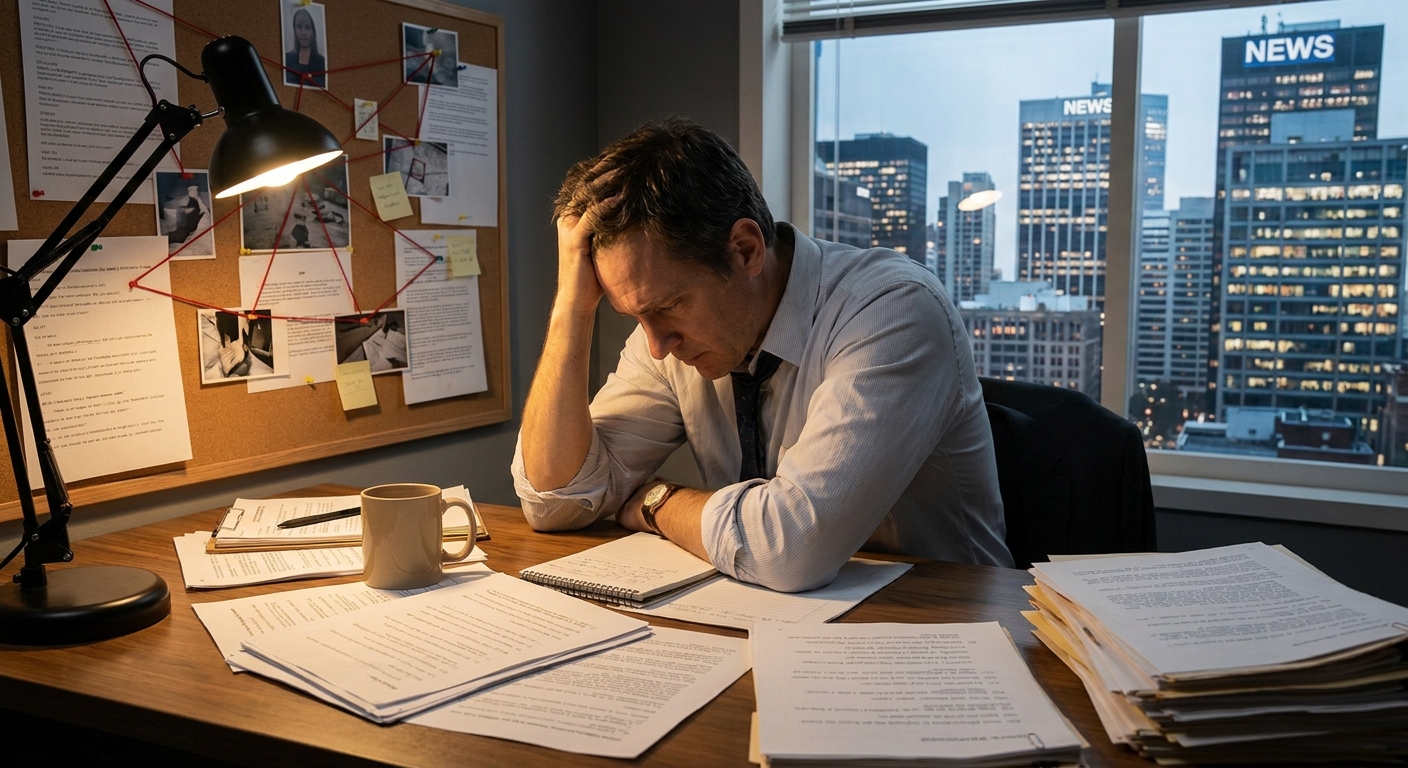
Investigative journalism is an act of assembly. A reporter working a long-form investigation does not sit down with a clean set of facts and arrange them into a narrative. They accumulate recorded material over weeks and months — interviews with sources who know partial truths, documents that contradict each other, testimony that evolves between the first conversation and the fifth. The story does not arrive whole. It emerges, slowly, from the mass of material.
What separates investigations that succeed from those that stall is not usually access to sources or quality of tip. It is the ability to manage material. And at the centre of material management in modern investigative journalism is the transcript.
Why Long-Form Investigations Live and Die by Transcription
A reporter covering a single press conference can work from rough notes. A reporter building a months-long investigation into institutional corruption, supply chain fraud, or systemic abuse cannot. The volume of recorded material alone makes notes insufficient. Forty interviews across eight months, each running forty-five minutes to two hours, produces upwards of fifty hours of audio. No reporter reliably remembers what source A said in interview three compared to what source B said in interview seven — and the discrepancies between those two accounts may be exactly what the story turns on.
Transcription converts that audio archive into a working document. Every word every source said is now text. It can be searched. It can be compared. It can be read in sequence or out of sequence. The investigation becomes navigable in a way that a folder of audio files never could be.
This matters most at the moment of cross-referencing. Investigative reporters spend enormous effort establishing whether sources corroborate or contradict each other — and precisely where. When a former executive says the practice began in 2019 and a mid-level manager says it began in 2017, that discrepancy is significant. Finding it requires not just remembering that both sources mentioned a date, but being able to pull both statements and place them side by side. Transcripts make that possible. Audio archives do not.
Managing Dozens of Sources Without Losing the Thread
The organisational challenge of a major investigation is underappreciated by people who have not done it. A reporter managing thirty or forty sources is dealing with thirty or forty partial, overlapping, sometimes contradictory accounts — each given by a person with their own interests, their own memory gaps, and their own reasons for telling the story the way they do.
The first discipline that transcription enables is tagging. When every interview exists as a searchable document, a reporter can mark every mention of a key person, every reference to a specific date, every description of a particular event. Across the corpus of all interviews, a search for a single name will surface every source who mentioned that person, in context, with their exact words. This kind of cross-referencing — which previously required a reporter to read and re-read every transcript by hand — becomes tractable when the material is in text form.
The second discipline is tracking source evolution. Sources in long investigations rarely say the same thing in interview one that they say in interview four. The story they tell changes as the investigation progresses, as they learn what else the reporter knows, as their own memory sharpens or shifts. Transcripts create a precise record of what a source said at each stage. That record protects the journalist — it establishes what was claimed when — and it allows the reporter to note where a source's account has moved and why that movement might matter to the story.
The third discipline is finding the line. In any large investigation, the actual story — the central narrative thread that will hold the piece together — is usually buried somewhere in the mass of material. It is the moment a source says something unrehearsed that changes the frame of everything else. It is the off-hand remark in interview twelve that connects two threads the reporter had been treating separately. These moments are impossible to plan for. They can only be found — and they are found by reporters who can move through their material quickly and precisely. Transcripts allow that movement.
The Source Protection Dimension
Investigative journalism involving sensitive sources carries obligations that go beyond good reporting practice. A source who speaks about institutional wrongdoing, government misconduct, or corporate fraud may be risking their career, their safety, or their legal standing. The way a journalist handles recorded material from that source is not merely a professional question — it is an ethical one.
Transcription, managed carefully, supports source protection in several ways. A transcript can be stored with the identifying details stripped or encoded, maintaining the evidential value of what was said while separating it from who said it. Audio recordings carry acoustic fingerprints — background noise, vocal characteristics, audio artefacts — that can in some circumstances help identify a source. A text transcript does not carry those fingerprints.
More practically, transcripts allow a journalist to prepare questions and verify information without returning repeatedly to a sensitive source. If interview three produced a claim about a specific date or document, the journalist can work from the transcript to verify that claim through other means rather than going back to the source and potentially exposing them to additional risk. The transcript becomes a buffer between the source and the investigation's public-facing work.
There is also the question of what happens if a journalist's notes are subpoenaed or seized. The legal landscape around journalist source protection varies significantly by jurisdiction, and the risks are real. A well-organised transcript archive with deliberate decisions about what is attributed, what is described, and what is retained gives a journalist's legal team something to work with. Careless recording practices do not.
Building the Investigation Chronology
One of the most powerful uses of a transcript corpus in a long investigation is chronological reconstruction. Investigations often concern events that unfolded over years. Each source has a partial view of that timeline — they were present for some things and not others, they heard some things second-hand and witnessed others directly. Assembling a reliable chronology requires pulling every chronological reference from every interview and organising them.
This work is painstaking when done from audio. From transcripts, it becomes a structured editing task. A reporter can search across all transcripts for every date reference, every phrase like "at that point" or "before the announcement" or "about six months later," and pull them into a working timeline. Discrepancies become visible. Corroborations become solid. The chronology that emerges is something the reporter can stake a claim on — not because they remember it that way, but because the record says so.
This matters enormously when the investigation goes to publication. Editors, fact-checkers, and legal teams will want to know the evidentiary basis for every factual claim. "Source A said this in interview three on this date, source B corroborated it in interview seven on this date, source C's account contradicts it in this specific way" is the kind of answer that a transcript-based investigation can provide. An investigation managed from rough notes and memory cannot.
When the Material Pushes Back
Not every investigation confirms its initial premise. Some of the most important journalism produced in the past decade has come from reporters who started with one hypothesis and found, in the material, that the reality was more complicated, or pointed in a different direction entirely. This is not a failure of reporting — it is what good reporting looks like. The willingness to follow the evidence rather than the expected story is the mark of serious investigative work.
Transcripts support this intellectual honesty. When a reporter has built a theory about what happened and then returns to the transcript archive and finds that three sources actually contradict a key element of that theory — in language that is unambiguous, in context that is clear — the transcripts make that contradiction impossible to ignore. The evidence is in text. It does not fade or shift with the reporter's memory or preferences.
This is the deeper value of thorough transcription in investigative work: not just that it makes the reporting more efficient, but that it makes the reporter more accountable to what the sources actually said, as opposed to what the reporter needed them to have said. That accountability is, in the end, what separates investigation from advocacy.
From Hours of Audio to a Story Worth Publishing
The final stage of any long-form investigation is synthesis — taking the mass of material and finding the shape of the story inside it. This is the hardest part of investigative journalism, and transcripts are the tool that makes it tractable.
A reporter with a full transcript archive can read across all their material in the way a writer reads a manuscript: looking for the moments of high drama, the revealing admissions, the places where a source said more than they intended. They can move between interviews non-linearly, following a thread from source to source. They can build a scene from multiple accounts, drawing on the exact words each source used to describe the same event, assembling a composite picture that is more complete and more credible than any single account.
The story that emerges from that process — built from verified, cross-referenced, precisely quoted testimony — is one that can withstand the scrutiny that serious investigative journalism attracts. It is a story built not on what the reporter believes happened, but on what the evidence shows.
XMOX transcribes interviews automatically and accurately, giving investigative reporters a searchable, secure record of every source conversation. Start building your investigation from solid ground — upload a recording and see your transcript in minutes.
Start free →