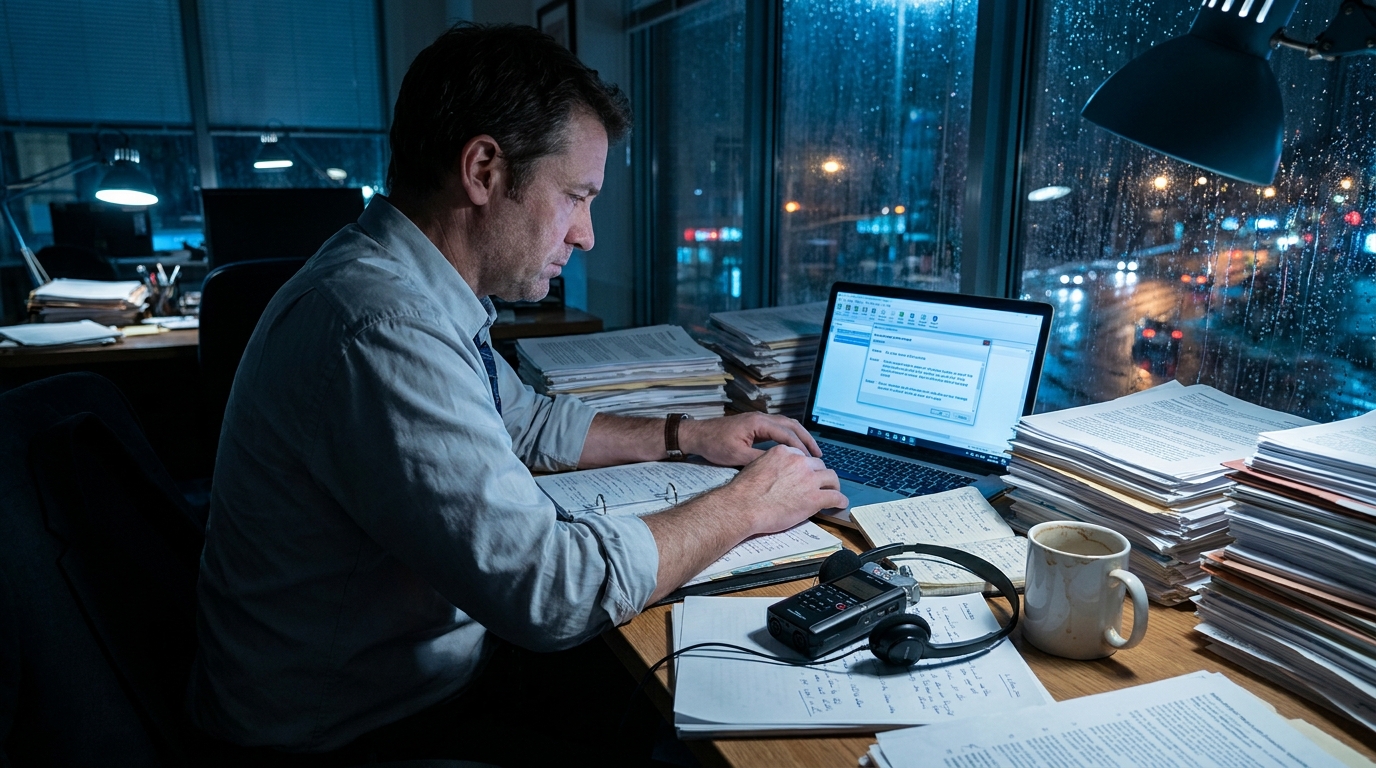
Journalism operates on the strength of its records. The quote attributed to a source, the statement denied by a spokesman, the document obtained under difficult circumstances — each of these is only as defensible as the journalist's ability to prove what was said, when, and by whom. In an era of legal threats, strategic denials, and editorial scrutiny, the question of how journalists document what they hear has become more consequential than it has ever been.
Transcription sits at the centre of that question. The journalist who can produce an accurate, timestamped record of what a source said — and did not say — is in a fundamentally different position from the journalist who is working from handwritten notes or unaided memory. The difference is not just operational. It is legal, ethical, and editorial.
The Evidentiary Problem in Journalism
Most journalistic disputes about accuracy come down to the same question: what exactly did someone say? This question is deceptively simple. Sources misremember or deny statements they made. PR representatives challenge characterisations of interviews conducted with their clients. Subjects claim to have been quoted out of context. Lawyers send letters demanding corrections, retractions, or threatening defamation proceedings.
In each of these situations, the journalist's position depends entirely on the quality of their record. A handwritten note taken during an interview is better than nothing. An audio recording is better still. A verbatim transcript, timestamped and searchable, is the strongest record a journalist can hold — because it removes ambiguity at every level. Not "I believe they said" or "my notes suggest" but "here is the exact sentence, at minute twenty-three of the recording, with the words in the order they were spoken."
This matters because journalistic credibility is asymmetric in disputes. When a powerful subject challenges a story, the assumption of good faith tends to favour the subject. The journalist who cannot point to a clear, contemporaneous record of what was said is in a structurally weak position, regardless of whether their account is accurate. The journalist who can is not.
Four Situations Where Transcription Changes the Outcome
1. Source disputes and denial
Sources who speak candidly to journalists sometimes regret it. The interview that seemed routine at the time becomes significant when the story is published. The source who said something revealing in the middle of an hour-long conversation may later claim they were misquoted, taken out of context, or that the quote reflects only part of what they said.
A full transcript of the interview is the definitive response to this kind of dispute. It shows not just the quote but the question that preceded it, the follow-up that confirmed it, and the surrounding context. If the source said what the journalist reported — and the transcript confirms it — the claim of misquotation is resolved. If the source said something more nuanced, the transcript shows that too, and the journalist has the opportunity to reassess before publication rather than defend an inaccuracy after it.
2. Legal challenges and pre-publication review
When a story touches on contested facts — allegations of misconduct, claims of fraud, criticism of powerful individuals or institutions — the legal review process that precedes publication depends heavily on the underlying documentation. Legal counsel advising on publication risk will want to know: is this quote accurate? Is there a record? Would the record withstand scrutiny in court?
A transcript provides answers to all three questions simultaneously. It also changes the nature of the legal assessment. A lawyer reviewing a story supported by transcribed interviews is assessing a different risk profile from a lawyer reviewing a story supported by handwritten notes and the journalist's recollection. The former is significantly more defensible.
3. Editorial verification and fact-checking
In newsrooms that take verification seriously, editors and fact-checkers independently review the evidence underlying claims in a story before it is published. This process — which is the internal equivalent of legal review — requires documentation that allows a second reader to independently confirm what was said.
Transcripts are the most efficient format for this process. An editor reviewing a key quote against a transcript can confirm it in seconds. The same editor reviewing the same quote against handwritten notes is doing interpretation rather than verification, because the notes are filtered through the journalist's earlier judgements about what was worth recording. The transcript removes that filter.
4. Correction and accountability
When errors occur — as they do — the process of identifying and correcting them is cleaner when the underlying record exists. A transcript makes it possible to determine with precision whether a quote was wrong, whether a paraphrase misrepresented a source's meaning, or whether a characterisation was accurate but incomplete. This benefits the journalist, the publication, and the source equally: the correction process becomes about establishing what actually happened rather than adjudicating between competing memories.
Source Protection and the Limits of Transcription
Accurate transcription strengthens accountability journalism. It also raises questions about source protection that journalists need to think through before they adopt it as a practice.
On-the-record sources. For sources who speak on the record, transcription is straightforwardly beneficial. It protects the journalist's characterisation of what was said, gives the source a basis for disputing inaccurate quotes, and strengthens the evidentiary record of the publication.
Off-the-record and background sources. For sources who speak in confidence, the transcript is a more sensitive document. A recording or transcript of a conversation with a confidential source — if it exists at all — must be handled with the same care as any document that could identify the source. This means secure storage, careful access controls, and a clear policy on when and whether recordings of confidential conversations are ever produced in legal proceedings.
Many journalists choose not to record conversations with confidential sources at all, preferring to rely on notes that do not create an audio trail. This is a legitimate editorial choice. The point is not that every journalistic conversation should be transcribed — it is that the conversations where accuracy is most consequential, and where the source speaks on the record, benefit significantly from the discipline of an accurate text record.
Consent. Recording a conversation requires the consent of all parties in many jurisdictions, and the rules vary significantly by location. Journalists working across jurisdictions — particularly in international investigative reporting — need to understand the recording consent laws that apply to each conversation they conduct. The practice of obtaining consent to record at the start of an interview is both a legal requirement in many places and a professional standard that protects journalists and sources alike.
The Discipline of the Full Record
There is a secondary benefit of transcription that goes beyond protection against disputes: it makes journalists more careful reporters.
When a journalist knows they have a full record of an interview, they approach both the interview and the writing differently. They are less likely to fill gaps in their notes with assumptions. They are more likely to return to the actual words a source used rather than their own paraphrase of those words. They are better positioned to notice when a characterisation in their draft does not quite match what the source said.
Experienced journalists know that memory is constructive, not reproductive. What we remember about a conversation is shaped by what we expected to hear, what confirmed our existing understanding, and what seemed most important at the time. The transcript is the check on that construction — the record of what actually happened rather than the record of what we thought happened.
This is not a criticism of journalistic memory. It is a recognition that any professional who relies on accurate recall of complex, often emotional conversations will produce better work with a verbatim record than without one.
Workflow Integration
The practical question for journalists is not whether transcription is valuable — it clearly is — but how it fits into a reporting workflow that is already time-pressured.
The most effective integration treats transcription as an automatic step in the process for any interview that will be quoted in a published piece. The interview is recorded with the source's consent, transcribed as quickly as possible after the conversation, and the transcript becomes the working document for the writing stage. Key quotes are pulled from the transcript rather than reconstructed from notes. The transcript is retained as part of the story's documentation for the period required by the publication's record-keeping policy.
For breaking news, where speed is paramount and transcription turnaround cannot wait, the transcript still provides value as a post-publication verification resource. A story published on deadline from notes can be checked against the transcript afterward, and any corrections identified before the story becomes the permanent record of the publication.
The time investment in transcription is front-loaded. A journalist who builds it into their workflow does not transcribe every conversation in full — they transcribe the conversations that matter, which produces a record when a record is needed.
What the Record Is For
The oldest argument for careful documentation in journalism is also the simplest: you are making claims about what people said and did. If those claims are wrong, people are harmed. If those claims are right but you cannot demonstrate that they are right, you cannot defend them. The record is the mechanism by which a journalist's work remains accountable not just at the moment of publication, but in the months and years that follow.
Transcription does not make journalism more cautious. It makes it more defensible — which, in the current environment, is the same thing as making it more durable.
XMOX transcribes journalist interviews quickly and accurately. Upload a recording, get a clean searchable transcript, and build the record your reporting depends on.
Start free →