Most qualitative research is designed as a snapshot. A researcher enters the field, conducts interviews, analyses the material, and exits. Longitudinal qualitative research operates on a fundamentally different logic. The object of study is not a state but a process — how attitudes shift, how experiences accumulate, how people make sense of change as it happens to them. The data are not collected once but repeatedly, from the same participants, across timepoints that may be separated by months or years.
That structural difference creates a documentation challenge that standard qualitative practice is not built to handle. When you return to the same participant for a third or fourth interview, you are not meeting a stranger. You are continuing a conversation with someone whose earlier statements, experiences, and language choices are all relevant context for what they say now. Without precise records of every prior session, that context is guesswork.
Transcription is the mechanism that makes longitudinal qualitative research tractable. Not audio recordings alone — recordings are archives, difficult to navigate and impossible to search. Transcription converts those archives into a living research infrastructure: text that can be searched, compared, coded, and cross-referenced across time.
The Specific Challenges of Multi-Wave Data
Longitudinal qualitative studies introduce difficulties that single-timepoint studies do not face. Understanding why transcription is so central requires understanding those difficulties clearly.
Memory decay. In a study that runs over eighteen months, the researcher who conducted Wave 1 interviews will not have reliable memory of those conversations by Wave 3. This is not a failure of rigour — it is biology. Precise transcripts are the only reliable substitute for a memory that degrades over time. When a participant in Wave 3 says "like I mentioned before, things at home have been complicated," the researcher needs to be able to trace exactly what the participant said in Waves 1 and 2, in their own words, with full context.
Participant drift detection. One of the primary analytical questions in longitudinal qualitative research is: what has changed, and how? Detecting genuine change requires a stable baseline. If the Wave 1 data exists only as rough notes or researcher summaries, the comparison is compromised — the researcher is comparing Wave 3 verbatim speech against Wave 1 paraphrase. Transcription ensures that every wave is documented at the same level of precision, making comparisons methodologically defensible.
Team continuity. Many longitudinal projects are conducted by teams rather than individual researchers, and the team composition may change over the course of the study. A graduate student who conducted Wave 1 interviews may have graduated before Wave 3 begins. New team members need to be able to read into the study — to understand not just what participants said but how they said it, what themes were emerging, what questions remained open. Transcripts are the document through which institutional memory passes from one team member to another.
Cross-participant pattern analysis. Longitudinal studies often aim to identify patterns across participants over time — not just how any one person has changed, but whether groups of participants have changed in similar or divergent ways. This kind of cross-timepoint, cross-participant analysis requires that data from all sessions be in a consistent, searchable format. Audio cannot serve this function. Text can.
Transcription as a Timeline Tool
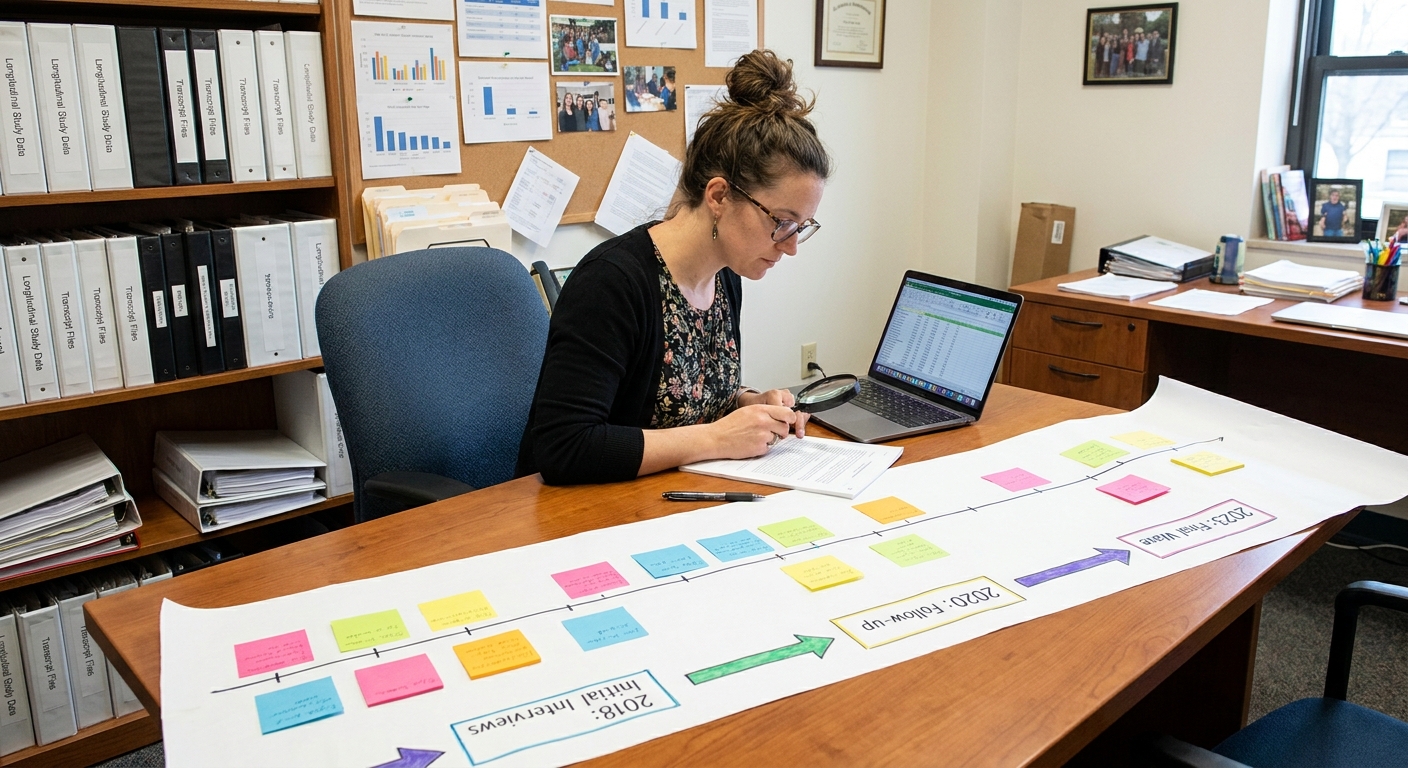
The most powerful function of transcription in longitudinal research is the one that is hardest to replicate without it: the ability to construct a verbal timeline for each participant.
Imagine a diary study tracking how individuals experience job insecurity over two years, with quarterly interviews. By the end of the study, each participant has generated eight interviews. If all eight are transcribed, the researcher can read through them sequentially and watch the participant's language evolve. They can identify the moment when "I'm trying not to worry about it" becomes "I've accepted that things might change," or when expressions of hope give way to resignation, or when resilience language emerges following a specific event.
This kind of close reading across time is the analytical heart of longitudinal qualitative research. It is what distinguishes the method from a series of disconnected snapshots. And it is only possible if the researcher has the full text of every session laid out in front of them — not recordings they have to re-play, not summaries that compressed the original language, but the actual words of the participant at each point in time.
The timeline function also supports interview preparation. Before each new wave, the researcher reviews the prior transcripts for that participant. They note unresolved threads — topics the participant raised but did not fully explore, questions left open, shifts in mood or language that warrant follow-up. This kind of preparation makes longitudinal interviews substantially richer than they would otherwise be. The researcher enters the room already knowing the participant's history, and can use that knowledge to ask precisely targeted questions.
Maintaining Participant Context Across Long Studies
Longitudinal research depends on something that single-session studies can take for granted: participant continuity. In a one-off interview, every participant is a fresh context. In a multi-year panel study, each participant arrives with an accumulating history that has to be held in mind throughout the session.
Transcripts are the primary tool for maintaining that history. Before each wave, researchers can generate participant-level summaries drawn directly from prior transcripts — the key themes, the participant's own language for their situation, the commitments and concerns they have expressed, the trajectory they have been on. These summaries, when grounded in verbatim transcript text, are far more reliable than impressions or memory.
They also support consistency. If a study protocol calls for tracking how participants respond to a specific recurring prompt, verbatim transcripts allow the researcher to verify that the prompt was delivered consistently across waves and to compare responses with confidence. Small variations in how a question was asked can produce meaningful variations in response; transcription makes those variations visible rather than obscured.
Cross-Timepoint Comparison in Practice
The methodological value of longitudinal transcription becomes concrete when researchers sit down to do cross-timepoint comparison. This is the analytical process of placing data from different waves alongside each other to identify change, continuity, development, or contradiction.
With full transcripts, this comparison can be conducted at multiple levels of granularity. At the macro level, the researcher can compare the overall themes and concerns a participant raised in Wave 1 with those they raised in Wave 4. At the micro level, they can track specific words or phrases across time — does the participant still use the same metaphor to describe their situation? Has their vocabulary around a sensitive topic shifted? These fine-grained analyses are only possible because the original language is preserved verbatim.
Transcription also enables systematic cross-participant comparison within a single timepoint. If Wave 3 data from twenty participants has all been transcribed, the researcher can search across all twenty transcripts for a specific phrase, theme, or concept. They can identify which participants are using similar language and hypothesize about what that commonality might mean. This kind of rapid cross-participant query is one of the capabilities that separates a well-documented longitudinal study from an unwieldy one.
Diary Studies and High-Frequency Data
Diary studies represent one of the most data-intensive forms of longitudinal qualitative research. Participants may contribute spoken diary entries daily or weekly over months, generating a volume of audio that would be unmanageable without transcription.
When diary entries are transcribed on a rolling basis — rather than accumulated and transcribed in bulk at the end of the study — the research team can monitor the evolving data in near real time. They can identify patterns as they emerge, flag participants whose entries suggest something worth following up, and adjust the study protocol if the data reveals something unexpected. This kind of adaptive research management is only possible if the data is in a form the team can actually read and search.
Rolling transcription also reduces the end-of-study bottleneck that plagues studies relying on post-hoc transcription. When a two-year study concludes, the prospect of transcribing hundreds of hours of audio is enough to delay analysis significantly. Continuous transcription distributes that work across the life of the study, so that analysis can begin earlier and proceed more smoothly.
Data Integrity and Methodological Rigour
Longitudinal qualitative research faces particular scrutiny around rigour. Critics of qualitative methods sometimes question whether findings are artefacts of interpretation rather than evidence of the phenomena being studied. One of the strongest responses to this concern is documentary precision: the ability to point to specific transcript passages, timestamped and attributed, that support the analytical claims being made.
Full transcription supports this kind of transparent, accountable analysis. Findings can be grounded in verbatim quotations drawn from specific sessions. Claims about change over time can be illustrated with parallel quotations from different waves. Analytical decisions can be justified by reference to the transcript record. This is qualitative rigour at its most defensible — not an absence of interpretation, but interpretation that is anchored in precise documentation.
For studies submitted to peer review or used to inform policy decisions, this kind of documentary foundation is not optional. Reviewers and policymakers need to be able to see the evidence, not just the conclusions. Verbatim transcripts are the evidence.
Starting a Longitudinal Study Right
The time to build transcription into a longitudinal study is at the design stage, not after data collection has begun. Researchers who treat transcription as an afterthought — something to be organised once the interviews are done — consistently find themselves overwhelmed by the accumulated backlog. The solution is to treat transcription as part of the data collection process: each session should be transcribed before the next one begins.
This approach means that the research team always has current, usable data. It means that participant summaries can be prepared before each new wave. It means that patterns can be identified and interrogated as they emerge, rather than all at once under end-of-study pressure. And it means that if something goes wrong — a recording fails, a participant withdraws, a team member leaves — the transcript record provides a stable foundation that limits the damage.
Longitudinal qualitative research is among the most demanding forms of social inquiry. It asks researchers to maintain methodological consistency across years, to hold the complexity of individual participant histories in mind, and to identify change through the texture of language rather than through numbers. Transcription is the infrastructure that makes this possible — not an administrative convenience, but the documentary foundation on which the entire enterprise rests.
XMOX transcribes every research session automatically and accurately. Whether you are running quarterly panel interviews or daily diary studies, upload your audio and get a searchable, annotatable transcript that keeps your longitudinal dataset consistent across every wave.
Start free →