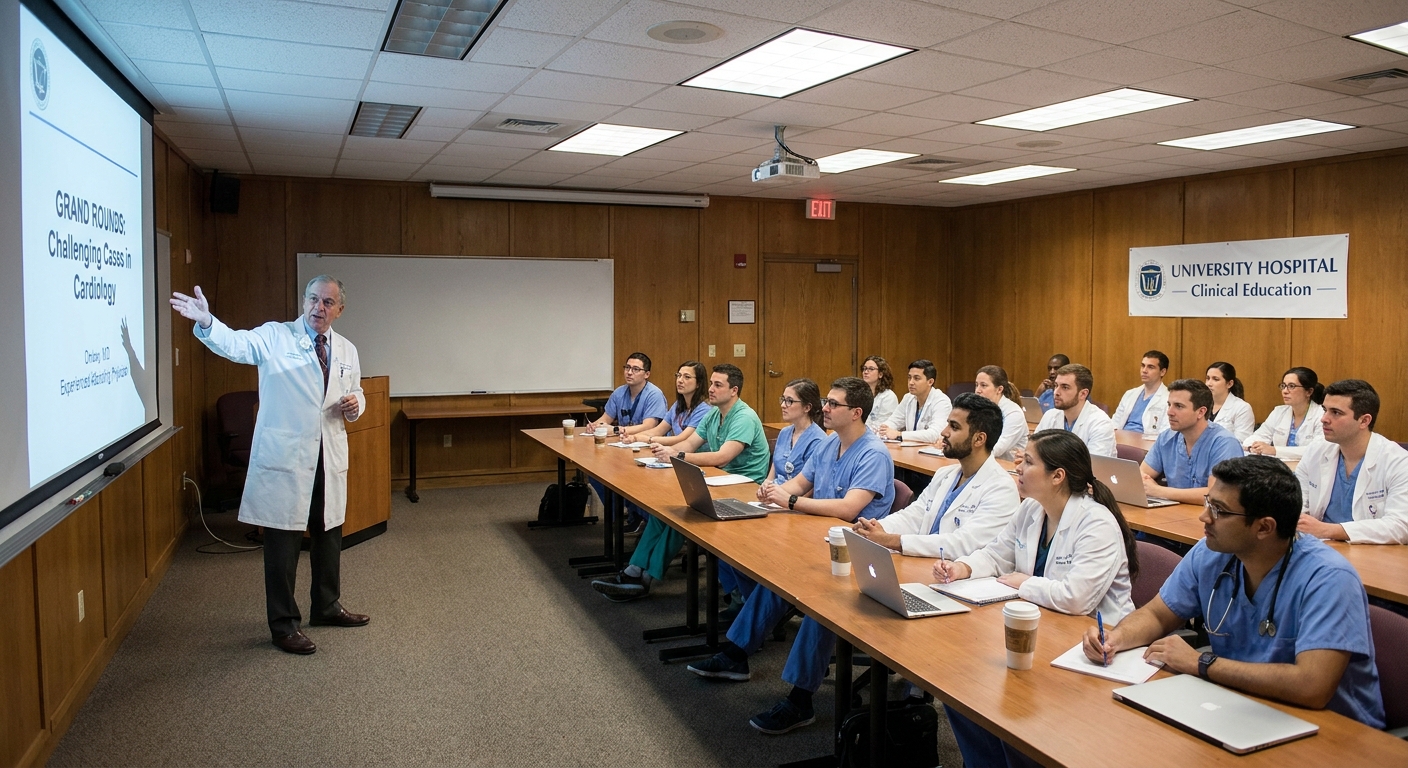
Ask any resident which experiences shaped their clinical thinking most, and the answer is rarely a lecture or a textbook. It is the case conference where a seasoned attending walked through a diagnostic dilemma in real time. It is the morbidity and mortality meeting where a team dissected what went wrong with honesty and precision. It is the tumor board where subspecialists reasoned out loud about competing treatment strategies for a complex patient. These are the moments where medicine is taught at its highest level — and they are almost entirely undocumented.
Grand rounds, multidisciplinary case conferences, tumor boards, and morning teaching rounds represent an enormous investment of institutional expertise. Departments gather their most experienced clinicians, invite guest faculty, and spend hours reasoning through difficult cases. Yet when the room empties, almost everything said evaporates. A trainee who attended can reconstruct fragments. One who missed the session has almost nothing. Neither has a record they can return to six months later when they encounter a similar case in clinical practice.
Transcription changes this. It converts the spoken reasoning of experienced clinicians into a permanent, searchable, reviewable record — and in doing so, it transforms how medical education preserves and transmits knowledge.
What Gets Lost When the Room Empties
The learning that happens in a grand rounds or case conference is qualitatively different from what happens in a lecture. A lecture transmits information. A case conference transmits reasoning — the way a clinician identifies which details matter, generates differential diagnoses, weighs competing hypotheses, and arrives at a decision under uncertainty. This kind of reasoning is extraordinarily difficult to teach from a slide deck and nearly impossible to absorb passively.
When trainees sit in on these sessions, they are watching a master class in clinical thinking. But the learning is heavily dependent on whether they were in the room, how closely they were paying attention, and how well their notes capture what was actually said. A complex discussion about whether to pursue a surgical versus medical approach for a borderline case might span forty minutes of nuanced back-and-forth. Even the most diligent note-taker captures perhaps a quarter of the reasoning that was expressed.
More problematically, trainees rarely know in the moment which parts of the discussion will prove most relevant to their own learning. The attending who spent twelve minutes explaining why a particular lab finding should shift the differential — that reasoning might not feel significant during the conference but becomes crucial three months later when a trainee encounters the same pattern on their overnight call. Without a record, that insight is gone.
Transcription as a Learning Tool for Trainees
When a case conference is transcribed, it immediately becomes a different kind of educational resource. A trainee who attended can return to the discussion and review it with a clarity that real-time note-taking never allows. They can move slowly through the reasoning, pause at the points that are most instructive, and absorb an argument that may have moved too quickly to follow in the moment.
A trainee who missed the session — on call, in the OR, or managing an emergency — is no longer left out of the educational content. They can read the full discussion at a time that works for their schedule. The educational value of the session is not limited to those who were physically present.
Transcripts also support the kind of retrospective learning that is particularly powerful in medicine. Reviewing a case conference discussion three months after the fact, with the benefit of knowing how the patient's situation ultimately resolved, allows a trainee to locate the moments where the eventual outcome was signalled by clinical reasoning — or where it was missed. This retrospective pattern-recognition is one of the most effective ways to build diagnostic intuition, and it is only possible when the original discussion is preserved.
Building Institutional Knowledge Across Programs
The knowledge generated in a single institution's case conferences is remarkable in its breadth and depth. Over the course of a year, a department's grand rounds, tumor boards, and M&M conferences will cover dozens of complex cases, rare presentations, diagnostic challenges, and management controversies. This is a curriculum — an implicit, informal curriculum that shapes clinical training — but it has never been written down.
Transcription makes it possible to write it down. When case conferences are routinely transcribed, the institution builds an archive of its own clinical reasoning. New trainees can access discussions from previous years. Faculty can review how the department approached a management question before current guidelines existed. Program directors can identify recurring diagnostic challenges and design formal teaching around them.
This institutional archive also serves as an onboarding resource for new faculty and fellows. When a clinician joins a program, they arrive without the accumulated context of the institution's previous cases. Access to a searchable archive of prior case conference discussions gives them a rapid way to understand how the department reasons, what its areas of expertise are, and what cases have shaped its current clinical practices.
Morbidity and Mortality Conferences: Preserving the Lessons
Morbidity and mortality conferences occupy a unique position in medical education. These are meetings where the medical profession holds itself accountable — where complications and adverse outcomes are examined with the explicit goal of preventing recurrence. The discussions that happen in these meetings are among the most educationally valuable in medicine, precisely because they are honest, specific, and anchored in real patient outcomes.
They are also, by their nature, among the least accessible to trainees who were not present. An M&M discussion might take place while a resident is on service in another part of the hospital. The case reviewed might be one they will never encounter a similar version of unless they happened to be in the room when the lessons were drawn.
Transcription preserves these lessons without compromising the confidentiality that makes M&M discussions possible. With appropriate de-identification practices, the reasoning — the analysis of what went wrong and why, the discussion of system-level versus individual factors, the identification of the decision point where a different choice might have changed the outcome — can be retained and reviewed. The educational value of the conference extends beyond the hour it occupied on a Tuesday morning.
Tumor Boards and Multidisciplinary Reasoning
Tumor boards are among the most intellectually demanding settings in medicine. Oncologists, radiologists, pathologists, surgeons, and radiation specialists each bring a distinct frame of reference to a case, and the discussion involves integrating those frames to arrive at a treatment recommendation. For trainees — whether oncology fellows, surgical residents, or rotating students — watching this integration happen in real time is an irreplaceable educational experience.
It is also an experience that is extremely difficult to absorb in the moment. The speed, the density of specialty-specific language, and the complexity of the reasoning mean that a trainee attending their first dozen tumor boards is likely to follow only a fraction of what is being said. Transcripts change this. A fellow who has attended a tumor board can return to the discussion, read it more slowly, look up the terms they did not know, and reconstruct the logic that connected the pathology findings to the final recommendation. Over time, this kind of deliberate review builds the multidisciplinary reasoning that is the defining skill of the subspecialist.
Teaching Rounds as a Searchable Resource
Morning teaching rounds — the daily walk through the ward where attendings, residents, and students review patients together — are where the vast majority of bedside teaching happens. These rounds are rich with clinical reasoning: the attending who explains why this patient's electrolyte pattern suggests something beyond simple dehydration, the discussion of which antibiotic choice reflects both the likely organism and the patient's renal function, the moment when a student's question prompts an attending to think out loud about a diagnostic uncertainty.
Much of this teaching is informal and unrepeatable. It arises from the specific patient in front of the team at that moment. But when rounds are transcribed, the teaching that emerged from one patient's case becomes a searchable record that can inform the care of future patients with similar presentations. A team that faced an unusual drug interaction on rounds in October has, if rounds were transcribed, a record of how that interaction was reasoned through — a record that is available when a different team encounters the same situation in March.
Improving Learning Retention Through Review
Medical education research consistently finds that distributed practice — returning to material multiple times over an extended period — substantially improves long-term retention compared to single-exposure learning. The problem with case conferences and teaching rounds is that they have always been single-exposure events. You attended, you absorbed what you could, and that was the extent of the learning opportunity.
Transcription creates the infrastructure for distributed practice. A trainee who reviews a tumor board discussion two days later, then again before a related case presents on their service, is engaging with the material in a way that builds durable knowledge. A resident who reads the M&M transcript before their own similar case goes to conference is preparing in a way that was previously impossible. The educational asset is no longer locked in a single moment in time.
Programs that have begun systematically transcribing case conferences report that trainees use the transcripts in ways that were not anticipated: reviewing discussions before board examinations, returning to specific cases when they encounter similar presentations in clinical practice, and using the archive to answer clinical questions that arise from their own patients. The resource turns out to be more broadly useful than simply a substitute for attendance.
Implementation: What Effective Medical Education Transcription Looks Like
The practical implementation is straightforward. A recording device or application captures the audio of the conference. The transcript is generated automatically and made available to program participants within hours of the session. With appropriate attention to patient privacy — de-identification of protected health information in accordance with institutional policy — the transcript is stored in a searchable archive accessible to faculty and trainees.
The most effective programs do more than simply archive transcripts. They tag discussions by diagnosis, clinical domain, and educational theme. A trainee preparing to manage a patient with a complex arrhythmia can search not just for "arrhythmia" but for the specific differential or management question they are facing. The archive becomes a clinical reference as well as an educational record.
Faculty engagement is the factor that makes or breaks adoption. When department leadership signals that case conference transcripts are a valued institutional resource — worth the time to review, worth tagging carefully, worth incorporating into formal curriculum — trainees use them. When transcripts are available but never mentioned in the formal educational programme, they are underused.
XMOX transcribes medical education sessions automatically and accurately, creating a searchable archive of your program's clinical reasoning. Upload a recording of your last grand rounds or case conference and see what your institution has been generating — and losing — every week.
Start free →