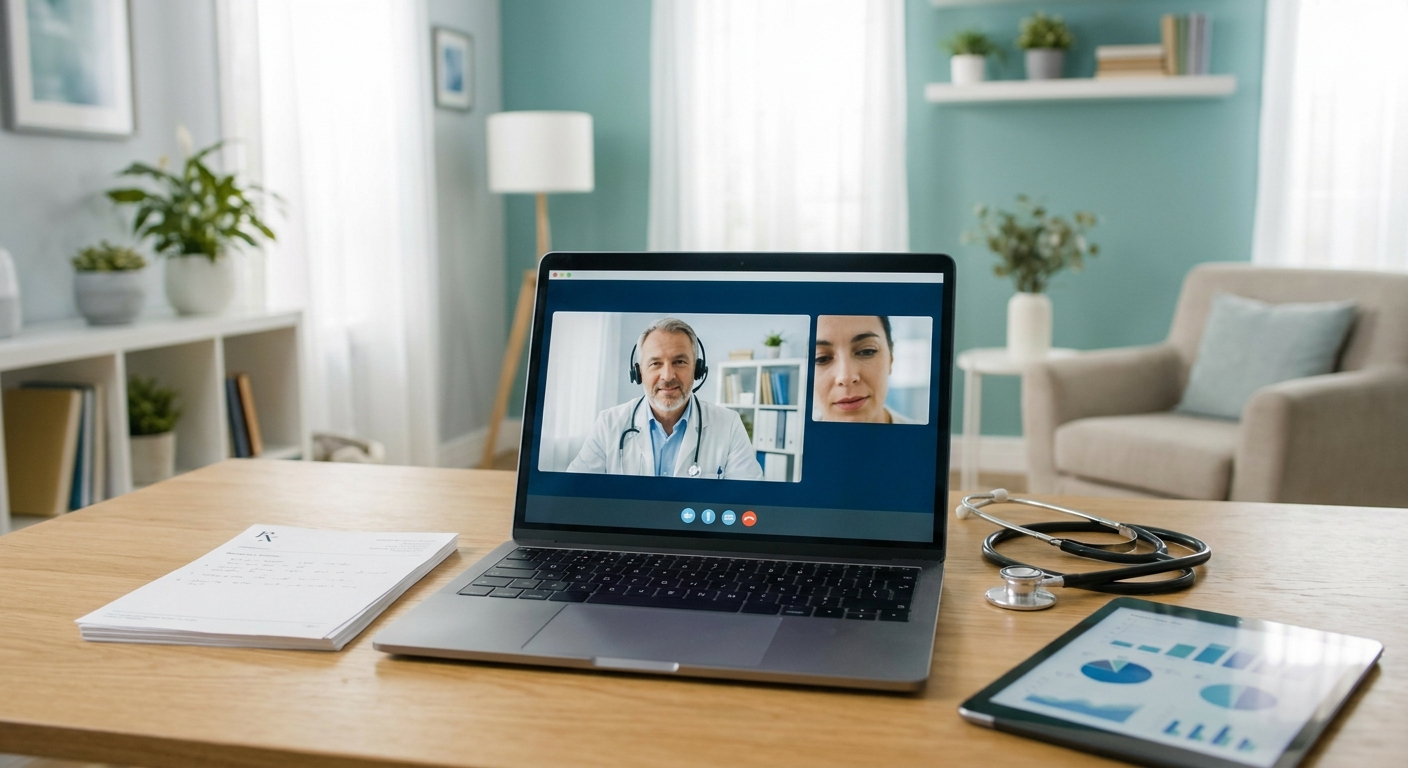
The rapid expansion of telemedicine — accelerated dramatically by the COVID-19 pandemic and now a permanent feature of healthcare delivery in most health systems — has surfaced a documentation challenge that in-person care never fully confronted. When a clinician and patient are in the same room, the ambient cues of a physical consultation — the posture, the pause, the hesitation before a disclosure — shape how the clinician records the encounter. The clinical note is written with the full sensory context of the room still present.
In a video or telephone consultation, that context collapses. The clinician works from a screen, often without the supporting infrastructure of a fully equipped clinical environment, frequently under time pressure from back-to-back virtual appointments, and always with the knowledge that the consultation exists only as audio and the notes that follow it. When those notes are incomplete, no physical examination room can fill the gap.
This article examines the specific documentation challenges that telemedicine introduces — and why transcription is the intervention most precisely suited to addressing them.
The Structural Documentation Problem in Virtual Care
In-person consultations benefit from a dense ecosystem of documentation support. The clinical environment itself prompts the clinician: equipment is to hand, referral forms are on the desk, the nurse has already taken observations and entered them into the record. Documentation is distributed across the encounter rather than concentrated at the end.
Virtual consultations strip this infrastructure away. The clinician must simultaneously conduct the consultation — maintaining therapeutic rapport through a screen, assessing symptoms without physical examination, navigating the technical difficulties that attend video calls — and manage documentation that has no physical environment to support it. The consequence, documented across multiple studies of telehealth implementation, is that clinical notes for virtual consultations are systematically shorter, less detailed, and more likely to omit key elements than notes for equivalent in-person encounters.
This is not a failure of clinical diligence. It is a structural consequence of asking clinicians to perform a cognitively demanding task without the environmental scaffolding that normally distributes its components. The clinician who finishes a face-to-face consultation and reaches for the keyboard has just been in the room; the clinician who ends a video call is reaching for the keyboard immediately after managing a screen-mediated conversation with none of the physical prompts that normally support recall.
Transcription restructures this problem. A full-text record of the consultation exists from the moment the call ends. The clinician's task shifts from reconstruction — re-creating from memory and sparse notes what was said over twenty minutes — to review and verification: reading an accurate record and adding clinical judgement, interpretation, and plan. This is a qualitatively different cognitive task, and it is substantially less demanding.
Regulatory and Compliance Requirements
Telehealth regulation has moved rapidly in most jurisdictions. As virtual care has become mainstream, the documentation standards applied to telemedicine have converged with those for in-person care — in some respects, they have become more demanding, because regulators are aware that virtual encounters are harder to audit and easier to inadequately document.
In the United States, the Centers for Medicare and Medicaid Services require that telehealth visits meet the same documentation standards as equivalent in-person visits to qualify for reimbursement. This means the record must demonstrate that the encounter satisfied the applicable level of service — history, examination (adapted for virtual settings), and medical decision-making — in a form that an auditor can verify. A sparse note that was adequate as a memory prompt for the treating clinician is not adequate as a reimbursement record.
In the European Union, the General Data Protection Regulation applies fully to telehealth records, with additional complexity from the cross-border data flows that telemedicine sometimes involves. The requirement to maintain accurate, complete records of consultations — and to be able to produce those records on request — is both a data protection compliance issue and a clinical governance issue.
Most medical regulatory bodies — the General Medical Council in the UK, the Medical Council of Ireland, the Collège des médecins in Quebec — have issued specific guidance on telemedicine documentation that emphasises the same core obligation: the record of a virtual consultation must be as complete and clinically defensible as the record of any other encounter. Transcription is the most direct route to satisfying that obligation without adding unsustainable time burden to the clinician.
Cross-Provider Continuity in Virtual Care
One of the structural differences between telemedicine and traditional in-person care is the frequency with which a virtual consultation involves a clinician who is not the patient's usual provider. On-demand telehealth platforms — those that connect patients to the next available clinician rather than to a named general practitioner — are built on the premise that good care is possible without continuity of relationship. This is true up to a point, but it places a much higher burden on documentation.
When a patient sees their usual GP in person, the clinician has contextual knowledge that supplements the formal record: they remember the conversation from three months ago, they know which complaints this patient tends to minimise, they can read the chart with the benefit of familiarity. A clinician seeing a patient for the first time on a video platform has only the formal record. If that record is incomplete — if a previous telehealth consultation produced a brief note that omitted key history, patient-reported symptoms, or the reasoning behind a clinical decision — the new clinician is working with a gap they cannot see.
Accurate transcription closes this gap. A complete record of each telehealth encounter — what the patient reported, what the clinician asked, what was discussed and decided, what advice was given — provides the next clinician with the substance of every previous consultation rather than its administrative summary. This is continuity of information even where there is no continuity of relationship, and it is an increasingly important patient safety mechanism in healthcare systems where on-demand virtual care is a routine access point.
Patient Comprehension and the Information Retention Problem
Patients retain a remarkably small proportion of the information communicated in a clinical consultation. Studies consistently find that patients forget between forty and eighty percent of what clinicians tell them within an hour of the encounter, and that the proportion retained decreases further over subsequent days. The impact of this retention failure is most severe when the information concerns a new diagnosis, a change in medication, or instructions for follow-up care — precisely the categories of information most clinically consequential.
Telemedicine compounds this problem. The absence of physical presence removes several of the cues that help patients anchor information to memory — the visual context of a clinic, the physical act of being examined, the literature handed over at the desk. Patients consulting by video are often in home environments full of competing stimuli. They may not have a notepad. They may not have told household members they are on a medical call and may be managing privacy alongside comprehension.
A consultation transcript provided to the patient directly addresses the information retention problem. The patient who cannot remember whether they were told to take the medication before or after food can consult the transcript. The caregiver managing an elderly relative's medication regime can verify what the clinician said against a record rather than reconstructing it from the patient's recall. The patient with health anxiety who immediately begins searching for information about their diagnosis can ground that search in what their clinician actually said rather than in an imperfect memory of it.
This is not a replacement for good consultation technique — the clinician should still structure information clearly, invite questions, and confirm understanding. It is a supplement that addresses the limits of memory independent of the quality of the consultation.
Medicolegal Protection in the Virtual Setting
Medicolegal disputes involving telehealth consultations present specific evidentiary challenges that are distinct from those arising in in-person care. In an in-person consultation, the clinical note is the primary documentary record but is supplemented by the physical environment, the presence of nursing staff, and the range of observations and measurements that are routine in a clinic. In a telemedicine consultation, the clinical note is often the only documentary record of the encounter.
When a patient alleges that a clinician failed to advise them of a risk, failed to ask about a symptom, or provided advice that differed from what the note records, the clinician's defence rests almost entirely on the quality of the documentation. A note that says "risks discussed" without specifying which risks were discussed and what the patient's response was provides little protection. A transcription that shows exactly what was said, when, and in what sequence provides a complete record that either substantiates the clinician's account or reveals exactly where the communication fell short — which is equally important for a fair resolution.
This protection runs in both directions. Just as an accurate transcript protects clinicians from unfounded allegations, it protects patients from having their complaints dismissed on the basis that the clinician's note — which they were not present to dispute — constitutes the authoritative record. A transcript that both parties can access is a more equitable evidentiary foundation than a single-author clinical note.
Technical Considerations in Telehealth Transcription
Telemedicine transcription presents some specific technical challenges that are worth understanding. Audio quality in video consultations is variable: network instability, background noise in home environments, and the acoustic characteristics of consumer-grade microphones all affect transcription accuracy in ways that controlled clinical environments do not. A consultation conducted by a patient using a phone in a car introduces a different quality of audio challenge than the same consultation in a quiet room with a headset.
Speaker identification is particularly important in telehealth transcription. Clinical notes need to distinguish clearly between what the patient reported and what the clinician assessed — conflating the two is a clinical safety issue, not just a formatting one. Transcription systems that accurately diarize speaker turns from a two-party video call substantially reduce the post-processing work required to produce a usable clinical record.
Integration with electronic health record systems is the third technical consideration. A transcript that exists as a separate document and must be manually reviewed and summarised before entry into the EHR adds a step to the clinical workflow that may reduce uptake. Transcription systems that output structured summaries, or that integrate directly with EHR platforms to populate structured fields, reduce the friction between transcription output and usable clinical documentation.
Implementation and Consent
Recording and transcribing a clinical consultation requires patient consent in virtually all jurisdictions. The consent process for telehealth transcription is in some respects simpler than for in-person recording — the virtual nature of the encounter makes it natural to present consent as part of the platform onboarding — and in other respects more demanding, because patients need to understand not just that the call may be recorded but how the recording will be used, who will have access to the transcript, how long it will be retained, and whether it will be stored by the healthcare provider, the platform, or a third-party transcription service.
Well-designed consent processes for telehealth transcription specify these details clearly and give patients a genuine choice — including the option to proceed without transcription, accepting that documentation will rely on clinician notes alone. In practice, most patients who understand the purpose of transcription and the safeguards applied to the resulting record consent to it; the information retention and care continuity benefits are typically persuasive when explained at the point of care.
Consent documentation should itself be retained as part of the encounter record, creating an auditable record of the patient's agreement to transcription that can be produced alongside the transcript in the event of any subsequent dispute about the encounter's scope.
The Broader Shift
Telemedicine is not a temporary adaptation; it is a structural change in how healthcare is delivered. As virtual care becomes a routine access point for primary care, specialist consultations, mental health support, and chronic disease management, the documentation infrastructure that supports it needs to be as robust as the infrastructure that has developed over decades for in-person care.
Transcription is a core component of that infrastructure. It addresses the cognitive challenge of real-time documentation without environmental support, satisfies regulatory requirements for complete clinical records, enables care continuity across providers who have no shared relational history, improves the information that patients take away from their consultations, and provides an evidentiary foundation that protects both clinicians and patients in a setting where the clinical note is often the only record.
The investment in telemedicine transcription is not a technology investment; it is a documentation quality investment — and documentation quality, in medicine, is a patient safety investment.