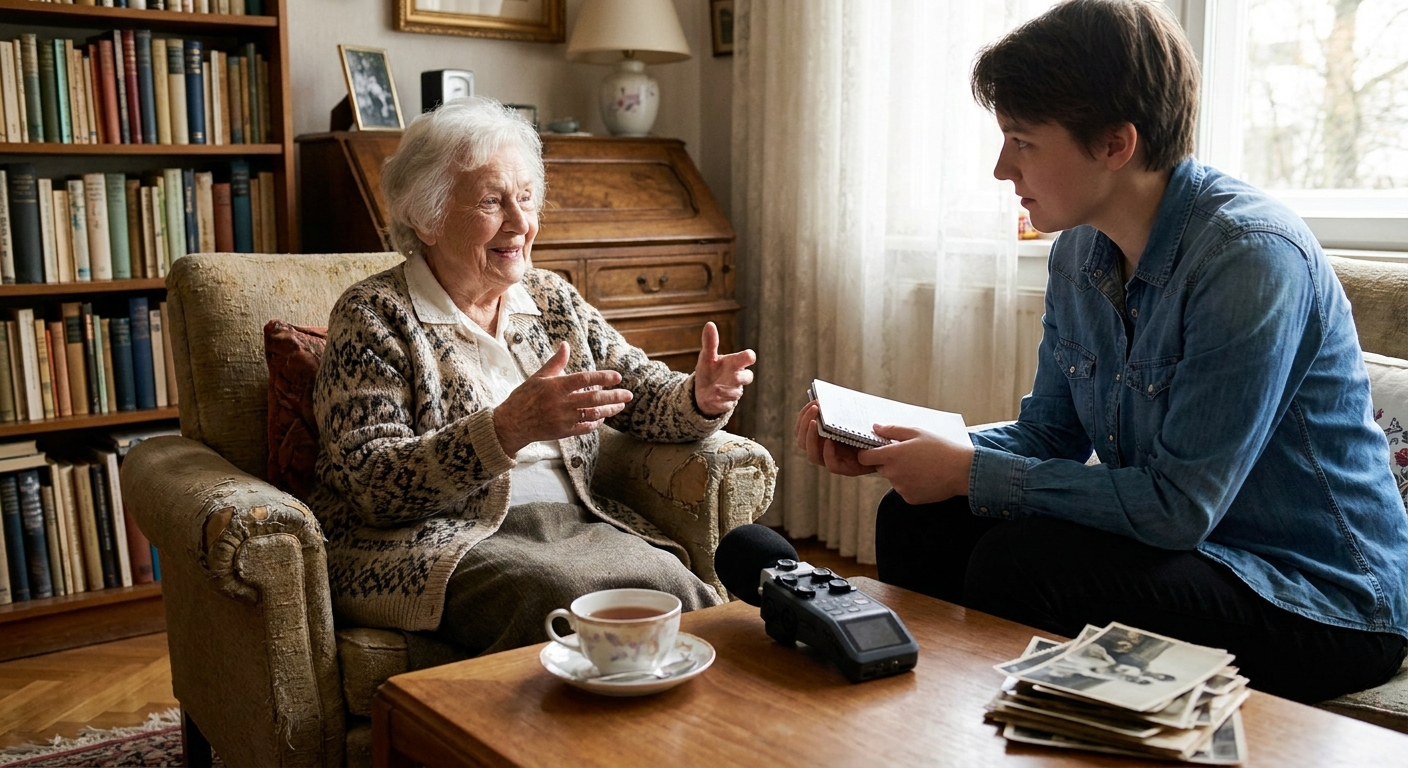
Oral history is one of the oldest forms of human knowledge-keeping, and one of the most irreplaceable. When an oral historian sits down with a World War II veteran, a civil rights marcher, an immigrant recounting the journey that shaped their family, or a craftsperson describing techniques passed down through generations, the resulting interview captures something no document can fully reproduce: the living texture of experience, told in the words of the person who lived it.
The challenge oral history has always faced is permanence. Sound recordings degrade. Tapes become unplayable. Formats become obsolete. The person who conducted the interview moves on, and the institutional memory of what was recorded fades. Transcription is the field's answer to that challenge — and understanding what good transcription looks like for oral history specifically is essential for anyone building an archive that is meant to last.
Why Oral History Transcription Is Different
Oral history transcription is not the same as transcribing a meeting, a lecture, or a podcast. The methodological stakes are different. A meeting transcript is a functional record of decisions and action items; its value is largely exhausted once those decisions are acted upon. An oral history transcript is a primary source. Future researchers will treat it with the same weight they assign to a letter, a diary, or a government document. The transcript may outlive every person who participated in the interview — the narrator, the interviewer, the institution that sponsored the project.
This means that accuracy in oral history transcription is not just a quality standard. It is an ethical obligation. The words belong to the narrator. Misrepresenting them — through careless transcription, through editorial smoothing that removes dialect or hesitation, through failure to capture what was actually said — is a form of distortion that corrupts the historical record.
At the same time, transcription always involves interpretation. A spoken utterance has tone, pace, emphasis, and silence that no written representation can fully capture. Oral history practitioners have developed conventions for marking pauses, false starts, laughter, and overlapping speech, precisely because these elements carry meaning that a bare text would strip away.
Archival Standards and Methodological Principles
The leading professional organisations in oral history — including the Oral History Association and the British Library Sound Archive — have developed guidelines that reflect decades of methodological debate. The core principles that emerge from those guidelines include:
Verbatim accuracy. The transcript should reproduce exactly what was said, including false starts, self-corrections, fillers such as "um" and "uh," and non-standard grammatical constructions. Editing the narrator's speech to make it conform to written grammatical conventions is considered a form of falsification. If the narrator says "we was living in that place," the transcript records "we was living in that place" — not "we were living in that place."
Notation of paralinguistic elements. Pauses should be noted, either with ellipses or with timed notations for longer silences. Laughter, crying, and other significant vocal events should be bracketed and described. When the narrator's meaning depends on emphasis — "I never said he took it" carries a different meaning depending on which word receives stress — some projects include notation for that emphasis.
Identification of inaudible or unclear passages. Every passage that cannot be confidently transcribed should be marked, with a note indicating whether it is inaudible or simply unclear. Guessing at inaudible words and presenting the guess as transcript is one of the most common and most damaging errors in oral history practice.
Contextual metadata. A transcript is only as useful as its metadata. The record accompanying each transcript should include the narrator's name, date and location of the interview, the interviewer's name, recording equipment used, and any relevant context about the narrator's background or the project's scope. Many archives also include a biographical note about the narrator prepared at the time of the interview.
Access and restriction agreements. Oral history narrators retain rights over their testimony. Transcripts should indicate the terms of the deed of gift or access agreement that governs how the transcript may be used — whether it is fully open, restricted to researchers, or restricted for a period of years.
Making Oral Archives Accessible to Future Researchers
An archive of recordings without transcripts is an archive that most researchers cannot use. Audio requires time, specialised equipment, and often knowledge of regional accents or period-specific vocabulary that makes comprehension difficult. A researcher working across a collection of two hundred interviews cannot listen to all two hundred; they need to search, scan, and assess relevance before investing time in the audio. Transcription is what makes that possible.
The searchability that transcription enables is not a secondary benefit. It is what transforms a collection from an archive into a resource. A historian studying the labour movement in a particular region can search a transcribed oral history collection for every instance of a key term — a specific union, a strike, a name, a workplace — and identify the interviews most relevant to their inquiry. Without transcription, the same search requires listening to each recording in full, which is practically impossible at scale.
Beyond search, transcription enables accessibility in the fuller sense: oral history collections become usable by researchers with hearing impairments, by non-native speakers of the interview language, and by those working in contexts where audio playback is not feasible. A transcript can be translated; an audio recording is far harder to make accessible across language barriers.
For community oral history projects — those created by and for the communities whose members are interviewed — transcription has an additional dimension. When community members can read as well as hear the words of their elders, the archive becomes a living resource within the community rather than a document deposited for academic use. Transcripts can be shared with families, published in community newsletters, or incorporated into local history exhibits in ways that audio recordings rarely are.
The Role of Technology in Oral History Transcription
For most of the field's history, transcription meant a trained transcriptionist listening to a recording and typing what they heard — a process that typically required four to six hours of work for every hour of audio. For large oral history projects, this was a significant bottleneck. Collections of hundreds or thousands of interviews remained untranscribed for years or decades simply because the labour cost was prohibitive.
Automated speech recognition has changed this picture substantially. Modern transcription services can produce a first-pass transcript of an oral history interview in minutes rather than hours, at a cost that makes transcription viable for projects that could never have afforded full manual transcription. For collections that were recorded but never transcribed, this represents an opportunity to catch up with decades of backlog.
The appropriate role of automation in oral history transcription is a genuine methodological question. The verbatim accuracy standard means that automated transcripts always require careful human review — a narrator's distinctive dialect, period-specific vocabulary, or references to local places and people will challenge even the most accurate speech recognition systems. The automated transcript is best understood as a draft that must be verified against the audio, not as a finished archival document.
At the same time, a reviewed automated transcript is far preferable to no transcript at all. Many experienced oral history practitioners now use a hybrid workflow: automated transcription produces the initial text, a trained reviewer checks it against the audio and applies the project's notation conventions, and the result enters the archive as a verified transcript. This approach makes systematic transcription of large collections feasible in a way it has never previously been.
Practical Considerations for Oral History Projects
For practitioners building or expanding an oral history collection, several practical points bear emphasis.
Decide on notation conventions before you begin, and apply them consistently. Whether you use a formal system such as the Jefferson transcription notation or a simpler house style, consistency across a collection is essential for researchers who need to interpret transcripts reliably. Document your conventions in a style guide that accompanies the collection.
Transcribe as close to the interview date as possible. The interviewer's memory of the recording context — what was happening in the room, what the narrator emphasised, what background noise can be heard — fades quickly. Interviewer notes and contextual memories that can inform the transcript are most accessible immediately after the interview.
Build review into the workflow, not as an afterthought. For projects using automated transcription, budget time for human review at the same rate you would budget for manual transcription. A first-pass automated transcript of a one-hour interview may take fifteen minutes to produce; a thorough review against the audio may take two hours. The review is not optional — it is where archival quality is established.
Consider narrator review where practical. Some oral history projects offer narrators the opportunity to review their own transcripts before they enter the archive. This practice has been debated within the field — it can surface factual corrections and clarify unclear passages, but it can also lead narrators to edit their speech in ways that alter the historical record. Projects that offer narrator review should have a clear policy on what kinds of changes are acceptable.
Plan for long-term preservation. A transcript stored only in a proprietary format or on a single institutional server is not truly preserved. Oral history transcripts should be stored in plain text or in widely supported formats, with backups in multiple locations. The goal is a transcript that remains readable in fifty years, which means avoiding dependence on any single software platform or institution.
Oral History as Living Archive
The voices captured in oral history interviews represent a form of knowledge that cannot be reconstructed once the narrators are gone. The veterans of the twentieth century's great conflicts, the survivors of atrocities and displacements, the witnesses to social transformations that reshaped communities and nations — these are voices for which there is no replacement. The archive that preserves them is not a repository of the past. It is a resource that future generations will draw on to understand who they are and where they came from.
Transcription is not a bureaucratic step in that process. It is the act that makes those voices permanently accessible — that transforms a recording into a document, a spoken testimony into a text that can be searched, cited, translated, and shared across the boundaries of time and place. Done well, with attention to archival standards and genuine fidelity to the narrator's words, oral history transcription is itself a form of preservation.
XMOX produces accurate, verbatim transcripts that oral history practitioners can use as the starting point for archival-quality documentation. Upload an interview recording and receive a transcript you can review, annotate, and deposit — preserving voices for the researchers who will come next.
Start free →