Every podcast episode is a content production event. A guest has been booked, a conversation has been researched and planned, recording and editing time has been invested, and a finished piece of audio has been published. What most podcast producers do next is move on to the next episode — and in doing so, they leave the majority of the value they just created locked in a format that most of their potential audience will never consume.
Audio is a constrained format. It requires dedicated listening time. It is not searchable. It cannot be scanned. It does not surface in text-based search results. It cannot be read at two in the morning when someone is lying in bed. It cannot be quoted in a way that links back to the source. The conversation that just happened — the insight, the story, the quotable moment — is available only to the listener who sets aside time to find the episode and listen to it in full.
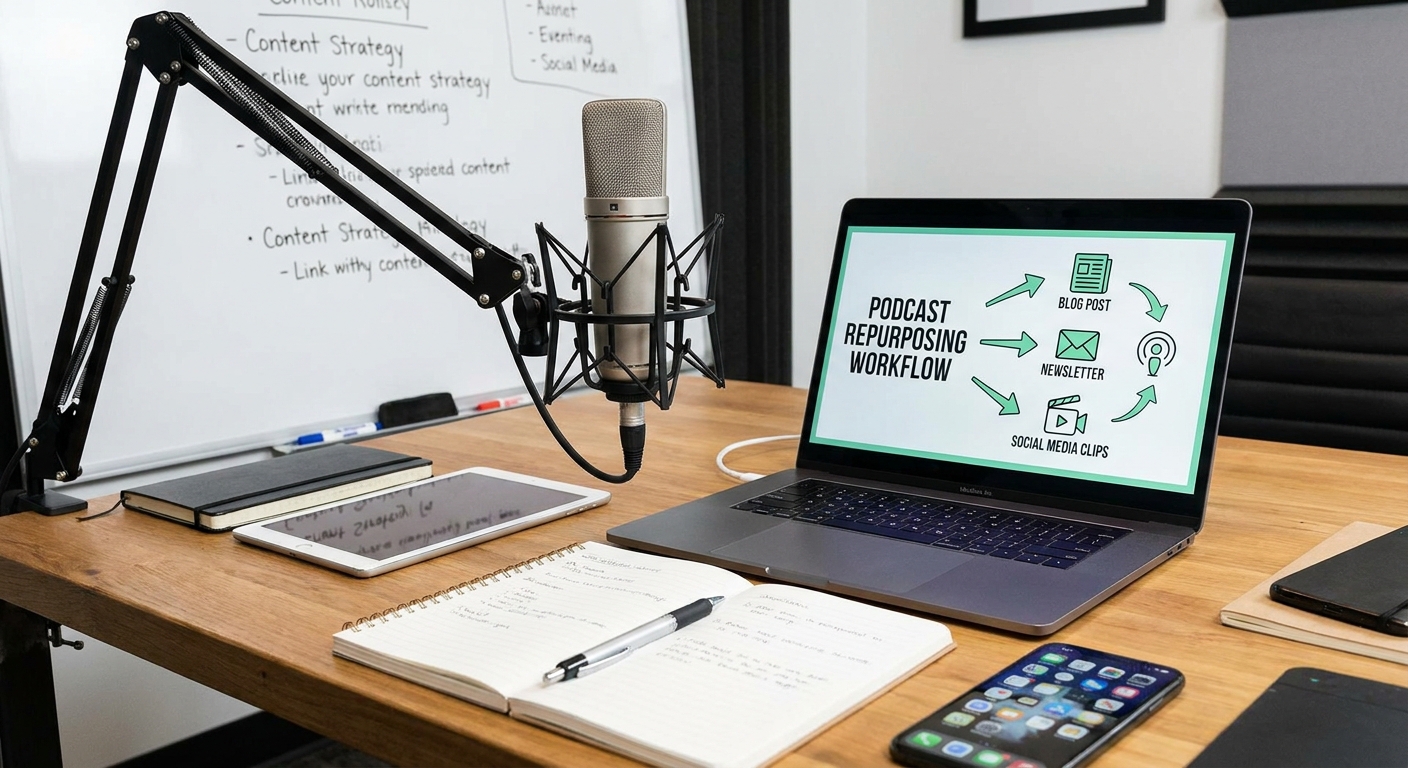
Transcription breaks that constraint. When an episode is transcribed, its content becomes accessible in every format: as a blog post, as a newsletter excerpt, as a social media thread, as a search-indexed article, as a quoted passage in another piece of content. The episode does not change. The reach of its content multiplies.
What a Transcript Enables
Blog posts and articles. The most direct repurposing of a podcast transcript is into written form for your website. This can range from a lightly edited version of the transcript itself — formatted with subheadings to make it navigable — to a substantively rewritten article that uses the transcript as raw material for a polished piece. Both approaches put the episode's ideas into a format that can be found through search, shared without listening, and scanned by readers who want to assess relevance before committing time.
The key distinction between a transcript-as-article and a transcript-as-transcript is editorial work. A raw transcript reads like speech, which is a fundamentally different register from writing: full of false starts, repetitions, conversational fillers, and sentences that make sense when heard but read awkwardly. Turning a transcript into a good article requires editing for written register — cutting the redundancy, restructuring for clarity, adding the context that in speech is conveyed by tone but in writing must be stated explicitly. The transcript is the material; the editor's job is to shape it into something that reads well on the page.
Newsletter content. Podcasts and newsletters are complementary formats that often serve the same audience — people who want to follow someone's thinking in depth over time. A newsletter that draws on recent episode transcripts can give subscribers who missed an episode the substance of what was discussed, give subscribers who listened a written version they can refer back to, and serve as a discovery mechanism for new subscribers who encounter the newsletter before they encounter the podcast. A well-structured newsletter excerpt — a key insight from the episode, a striking quotation, a summary of the main thread — takes thirty minutes to write from a transcript that took an hour to record.
Social media content. Podcast transcripts are a gold mine for social content, primarily because they contain quotable material that was created in the course of a natural conversation rather than crafted for distribution. When a guest says something striking — a counterintuitive claim, a vivid analogy, a sharp summary of a complex idea — that quotation exists in the transcript waiting to be used. Pulled quotes, threaded explanations of a key idea from the episode, and short-form summaries of a discussion are all significantly easier to create from a transcript than from memory or from re-listening to an episode.
Search engine optimisation. Audio is invisible to search engines. The ideas discussed in a podcast episode, the expertise of the guest, the specific questions addressed in the conversation — none of it surfaces in a Google search unless it exists somewhere in text. Transcripts, published on the episode page or as standalone articles, make podcast content searchable. A potential listener searching for an answer to a specific question may find the episode through a text excerpt that would never have surfaced through the audio alone. Transcript-based SEO is one of the lowest-effort ways to grow podcast discovery through search, because the raw material already exists — it just needs to be made text.
Show notes and episode summaries. Every podcast episode needs show notes. Those notes — the summary of what was discussed, the key topics, the timestamps, the links mentioned — are dramatically easier to produce from a transcript than from memory or re-listening. A producer with a transcript can scan the text, identify the key topics in sequence, pull the relevant timestamps, and draft show notes in a fraction of the time it would take to reconstruct the same information from audio.
The Quotable Moment Problem
One of the under-appreciated challenges of podcast content is finding the quotable moments. A one-hour episode may contain a dozen moments where a guest says something genuinely striking — a claim that challenges received wisdom, an analogy that makes a complex idea suddenly clear, a personal story that lands with emotional force. In audio, those moments exist but cannot be located without listening to the full episode or spending significant time scrubbing through the recording.
In a transcript, they are findable in seconds. A producer reading through a transcript can identify quotable moments by visual scanning, mark them, and extract them for use across channels. The same searching capability means that when a guest's insight becomes relevant in a different context — when a topic they discussed comes up again in the news, when a claim they made is relevant to a new conversation — the moment can be located and reused without re-listening to the episode.
This is the compounding value of transcript archives. An episode recorded three years ago remains extractable. A guest's insight about a topic that has since become prominent can be surfaced and redistributed. The transcript turns the episode from a time-stamped event into a permanent resource.
Practical Workflow for Transcript-Based Content Production
The most effective transcript repurposing workflows treat the transcript as the first step in a production pipeline rather than the last step in an episode workflow. The practical sequence looks something like this:
Transcribe immediately after recording. The sooner the transcript is available, the more options exist for repurposing before the episode publishes. A transcript produced the same day as the recording allows the producer to plan repurposing content in parallel with editing, rather than after publishing.
Read for structure before writing. A first pass through the transcript identifies the main threads: what was the central claim, what were the key supporting points, what were the moments of most significant insight, what was the strongest quotation. This structure maps to the episode's content and serves as the outline for any written versions.
Decide on register before editing. Is the output a lightly edited transcript or a fully rewritten article? These are different tasks requiring different editorial approaches. The lightly edited version preserves the conversational register with minimal intervention. The rewritten article uses the transcript as source material for a piece that reads as if it were written rather than spoken. Neither is inherently better — it depends on the audience, the purpose, and the available time.
Extract quotes separately. After the main content is drafted, a separate pass through the transcript to extract the strongest quotations for social media and newsletter use is worth the investment. A file of ten to fifteen strong quotes from the episode, each with a timestamp reference, is a content asset that can be drawn on over weeks of social media posting.
The Multiplication Effect
The return on transcription for podcast producers is not just the transcript itself — it is the multiplication of a single recorded conversation across every channel where the audience can be reached. An hour-long episode that exists only as audio reaches the listeners who find it and set aside time to listen. The same episode with a transcript published on the website, an article drafted from the key ideas, a newsletter excerpt sent to subscribers, and a week of social content pulled from the quotable moments reaches a substantially larger and more diverse audience — people who search, people who scan, people who read but do not listen.
This is not about diluting the podcast by converting it into other formats. The audio episode remains the primary product. Repurposing the transcript is about ensuring that the ideas in the episode reach people in the format they are actually prepared to consume them in — and about building a content operation that extracts the full value from every conversation that is recorded.
XMOX transcribes podcast episodes accurately and immediately, giving producers the raw material they need to repurpose every conversation across blogs, newsletters, social, and search. Try it free on your next episode.
Start free →