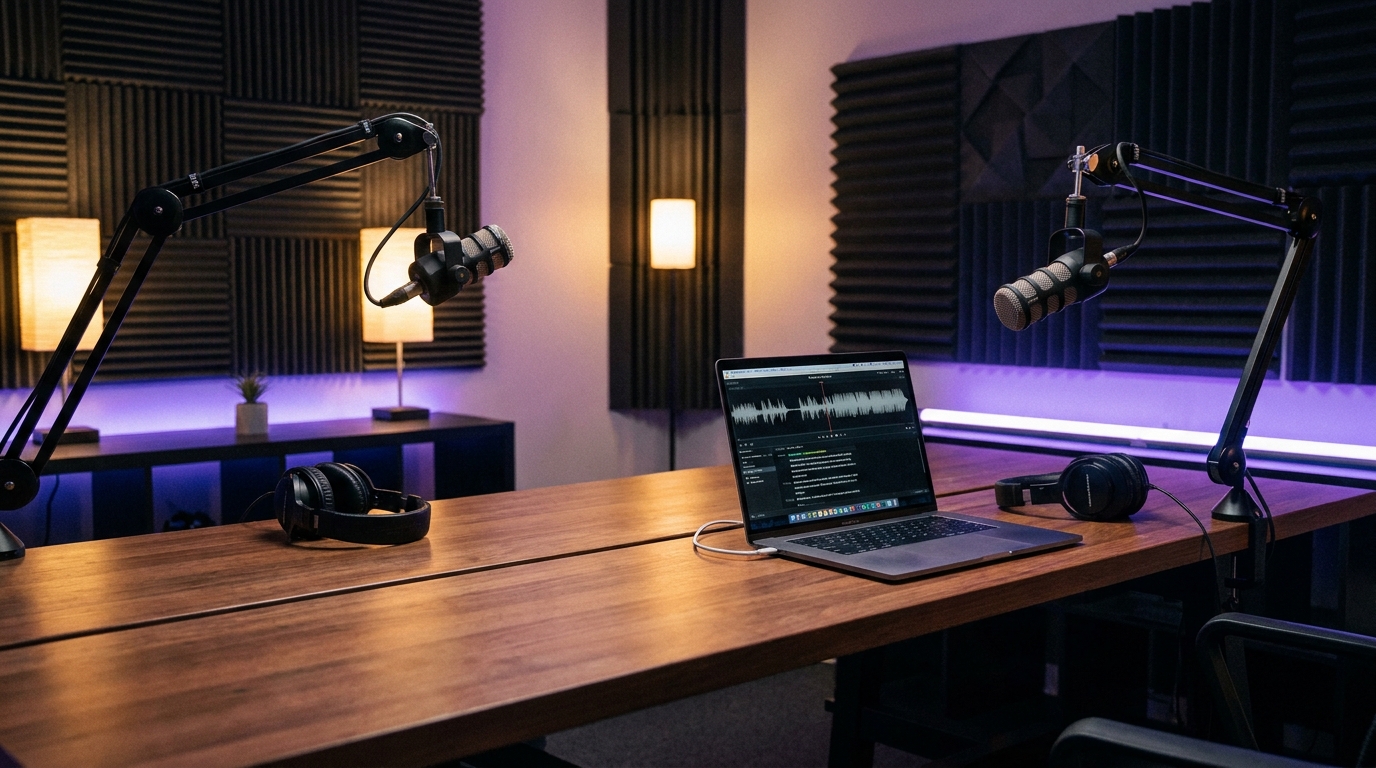
Recording a podcast episode is the beginning of the work, not the end. Once the audio is done, most creators face a familiar stack of tasks: write show notes, pull timestamps, extract quotable moments, draft a newsletter summary, create social captions, and — if they have the time and inclination — publish a full transcript for accessibility and SEO. For independent podcasters, this post-production workload often consumes more hours than the recording itself. For shows with editorial teams, it creates bottlenecks that slow down publishing schedules and increase costs.
AI transcription changes the economics of that stack. When you have an accurate, searchable text version of your episode, most of those downstream tasks collapse from hours into minutes. The transcript is not just a transcript — it is a content asset that the rest of your workflow runs on.
What You Actually Get From a Transcript
A podcast transcript is often framed as an accessibility feature — something you produce for listeners who are deaf or hard of hearing. That framing undersells it considerably. A full-text transcript is one of the most versatile assets in your content operation.
Show notes. Good show notes are a structured summary of the episode: the main topics, key insights, timestamps, and links. Creating them from scratch, starting from memory or rough listening notes, is slow. Creating them from a transcript is fast — you can scan the text, find the moments that mattered, pull exact quotes, and map timestamps directly from the transcribed text. What used to take forty-five minutes takes ten.
Full episode transcripts. Publishing the full text of an episode on your website is one of the highest-impact SEO actions a podcaster can take. Search engines cannot listen. They can read. A complete, accurate transcript on your episode page turns audio content into indexable text, making your episodes discoverable for every topic, guest name, and specific claim discussed. Over time, a library of transcribed episodes compounds into significant organic search presence.
Blog posts and articles. A well-structured episode interview or solo episode often contains the raw material for a standalone article. The transcript is the first draft. With editing — trimming conversational filler, restructuring for written flow, adding subheadings — a fifty-minute conversation can become a 1,200-word piece that stands on its own. This is content repurposing at its most efficient: the thinking was already done on the mic.
Social content. The best moments in any episode — sharp observations, counterintuitive claims, quotable exchanges — are easily missed when you are editing audio. Working from a transcript, you can scan the text and identify the moments worth highlighting. Pull a quote for a LinkedIn post. Extract a thirty-second exchange for a short video clip. Build a Twitter/X thread from the episode's key arguments. The transcript is your content mine; the social posts are what you extract from it.
Newsletter summaries. If you run an email newsletter alongside your podcast, the transcript gives you a clean starting point for each issue. Instead of listening back through an episode to remember what was covered, you can read the text, pull the three most important ideas, and write the newsletter from that rather than from scratch.
Searchable episode archive. As a podcast grows, its back catalogue becomes an asset — but only if it is accessible. A text-indexed archive lets you search your own content: find the episode where a particular topic was discussed, locate a specific guest's contribution across multiple appearances, or retrieve the exact quote you vaguely remember from two years ago. This is not only useful for your own production work; it is increasingly useful for listeners who want to find specific content within a large library.
Where Manual Transcription Falls Short
Human transcription has always been accurate, but it has two significant drawbacks: cost and turnaround time. Professional transcription services typically charge per minute of audio. For a weekly show with hour-long episodes, that cost compounds quickly — and a twenty-four to forty-eight hour turnaround does not fit a same-day publishing workflow.
DIY transcription — creators typing their own transcripts — is effectively not viable at scale. Even at a fast typing pace, transcribing a sixty-minute episode takes three to four hours. The labour cost exceeds the content value for most shows.
Automated transcription has historically been the compromise: fast and cheap, but requiring significant correction work, particularly for shows with multiple speakers, technical vocabulary, or non-native English accents. The accuracy gap was manageable for SEO transcripts but not for show notes or published articles where precision matters.
Current AI transcription has largely closed that gap. Accuracy on clean audio — a well-recorded interview or solo episode — is high enough that post-editing is a light pass rather than a thorough correction process. The workflow cost of transcription has dropped to the point where it fits naturally into a standard production week.
Building Transcription Into Your Production Workflow
Step 1: Transcribe immediately after recording. The most efficient place for transcription in your workflow is right after the raw audio is complete, before editing. You get an uncut transcript of everything said — which is actually more useful than a transcript of the final edit, because it includes moments that get cut from the audio but could still appear in written form.
Step 2: Use the transcript to guide editing. Many editors find that reading the transcript first makes the audio editing process faster. You can identify the structure, mark the sections to keep and cut, and spot the key moments before you open the timeline. The transcript becomes a script for the edit rather than an output of it.
Step 3: Pull show notes from the transcript. With timestamps visible in the transcript, assembling show notes becomes a matter of selection rather than composition. Scan for topic transitions, pull the timestamps, extract two or three direct quotes that capture the episode's best moments, and you have the raw material for a complete set of notes.
Step 4: Publish the transcript on your episode page. A full transcript does not need to be beautifully formatted to be effective. Clean paragraphs with speaker labels and timestamps is sufficient for both readers and search engines. If you use a podcast hosting platform that supports embedded transcripts, publish it there too — several platforms now surface transcripts in search results and recommendation engines.
Step 5: Repurpose systematically. Once the transcript is published, set a consistent process for repurposing: one social quote per episode, one longer clip if the content warrants it, and the newsletter summary drafted from the transcript. Batching this work — doing all social pulls for the week from transcripts on a single day — is significantly more efficient than returning to audio for each task.
A Note on Accuracy and Speaker Identification
AI transcription produces the best results when the audio quality is good: minimal background noise, a reasonable recording environment, and speakers who are close to their microphones. Most dedicated podcast setups already meet these conditions.
Speaker identification — the ability to label different voices in the transcript — has improved substantially and works well for two-person conversations. For panel shows with three or more distinct speakers, some manual labelling may still be needed, but the improvement in diarisation over the past two years means this is increasingly a minor correction task rather than a significant one.
Technical vocabulary — industry-specific terms, product names, or niche jargon — remains the category where automated transcription is most likely to produce errors. A light review pass, focused on any technical terms introduced in the episode, catches most of these quickly.
The Cumulative Value
The benefit of integrating transcription into your podcast workflow is not just the hours saved on each episode — though that is real and significant. It is the compounding value of the text archive you build over time.
A podcast with fifty transcribed episodes has fifty indexable web pages, fifty pieces of repurposable content, and fifty entries in a searchable knowledge base. A podcast with two hundred transcribed episodes has a content library that most written publications would envy. The search traffic, the backlink potential, the ability to find and reference your own material — these are benefits that accumulate with each episode and do not require any additional work once the transcription habit is established.
For creators who are serious about building an audience over a long timeline, the transcript is not optional infrastructure. It is the thing that turns a series of audio files into a sustainable content operation.
XMOX transcribes your podcast episodes accurately and quickly. Upload an episode, get a clean transcript, and start building the workflow that makes every recording work harder.
Start free →