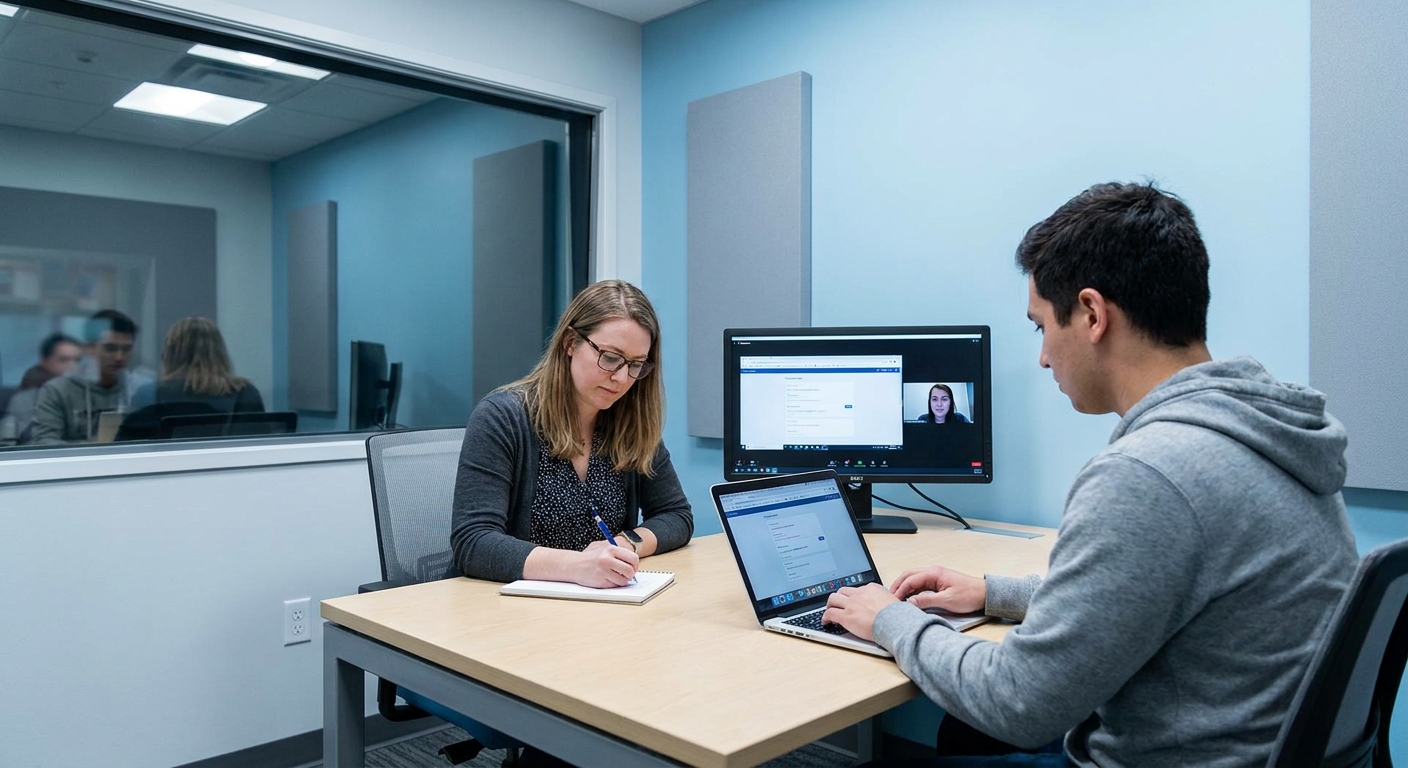
The think-aloud protocol is one of the most powerful tools in user research. When participants narrate their experience as they interact with a product — saying what they see, what they expect, what confuses them, what they are looking for — they produce a running verbal account of the cognitive process that underlies user behaviour. This is not feedback collected after the fact; it is behaviour captured in the act. The verbal stream is the data.
Which makes what happens to that verbal stream after the session a critical research decision. In many UX research operations, the researcher's notes and a highlights reel of screen recordings are the primary deliverables. The session audio is retained but rarely consulted. The consequence is that the richest data generated by the research — the participant's own words, in the sequence they were spoken, with the hesitations and corrections that reveal the shape of their confusion — is systematically underused.
Verbatim transcription of usability sessions changes this. It turns the audio record into a first-class data asset that can be searched, coded, quoted, and compared across sessions in ways that recordings and observer notes cannot match. This article examines why, and what the practical implications are for research teams that are deciding how to invest their documentation effort.
The Observer Note Problem
Every usability researcher knows the experience of reviewing their session notes the following morning and finding that what seemed like a comprehensive record during the session is, in the cold light of retrospect, a partial account filtered through the researcher's prior hypotheses. The note says "user struggled with navigation" but does not capture what the user actually said at that moment — whether they expressed frustration, confusion, or resigned acceptance; whether they attributed the difficulty to themselves or to the interface; whether they tried one workaround or three before giving up.
Observer notes are inevitably interpretive. The researcher is not a stenographer; they are simultaneously facilitating the session, tracking task completion, noting emotional cues, managing time, and writing. In that context, what gets written is what the researcher judges salient — and that judgement is shaped by what they already believe about the product, the users, and the research questions. Notes are not a record of what happened; they are a record of what the researcher noticed.
This is not a criticism of researcher skill. It is a description of the cognitive limits of real-time observation under divided attention. The problem is not avoidable through better note-taking; it is structural. The only solution is a parallel record that is not filtered through the researcher's attention at the moment of capture.
A verbatim transcript is that parallel record. It captures everything the participant said, including the things the researcher did not note because they did not yet appear significant. The comment that seemed like a passing remark during the session — a brief aside about an unexpected affordance, a half-sentence about a competitor product, an expression of surprise that was over in two seconds — may turn out to be the most analytically important moment in the data set. It will only be available for that reinterpretation if it was captured in the transcript.
Pattern Recognition Across Sessions
A single usability session produces an hour of rich data. A usability study typically involves five to twelve sessions. The research value is not in any single session but in the patterns that emerge across them — the navigation confusion that eight out of ten participants encountered, the terminology that consistently triggered incorrect expectations, the feature that was used in a way the design team never anticipated.
Identifying these patterns from recordings and observer notes is a laborious process. The researcher must review multiple hours of video, cross-reference note documents, and hold the evolving pattern in working memory across multiple review cycles. The cognitive demand of this process is substantial, and it creates systematic risks: patterns that were visible in early sessions influence how the researcher attends to later ones; observations that appear in only one note document may be overlooked when synthesising across five; the pattern that emerges from the verbatim record may differ from the pattern that emerges from the highlights reel.
Transcripts transform pattern recognition by making the data set searchable and comparable. If a researcher wants to know how many participants used the word "confusing" or a synonym to describe the checkout flow, a transcript search answers that question in seconds. If they want to compare how different participant segments described the same feature, they can pull all relevant passages from the transcript set and read them side by side. If they want to trace how a user's language about a product changed between the start and end of a session — which often reveals the degree to which the product communicated its own logic — the transcript makes that longitudinal reading possible in a way that a highlights reel does not.
This searchability also supports rigorous affinity mapping and thematic analysis. Research teams that use structured analysis frameworks — Jobs-to-Be-Done, opportunity scoring, experience mapping — benefit from being able to extract and sort participant quotes at the level of granularity that the framework demands. Observer notes rarely achieve this level of granularity; transcripts routinely do.
Exact Quotes and Stakeholder Persuasion
Research findings land differently when they are supported by the participant's exact words. "Users found the onboarding confusing" is a researcher's summary. "I keep looking for a back button — I don't know how to get out of this without starting over" is a participant's experience, quoted directly. The second statement is more vivid, more concrete, and more difficult to dismiss than the first. It is also more honest: it represents what was actually said rather than the researcher's characterisation of what was said.
Product teams and stakeholders are frequently sceptical of research findings, particularly when those findings challenge decisions that have already been made or require significant development investment to address. The most effective counter to that scepticism is not a better-argued summary; it is specific evidence. A report that quotes five participants describing the same difficulty in their own words is harder to dismiss than a report that asserts the difficulty exists.
Accurate transcription makes this kind of evidentiary reporting straightforward. The researcher can locate any moment in any session, pull the exact quote, verify it against the recording, and include it in the report with confidence that it represents what was said rather than what the researcher remembers was said. This is a qualitative analogue to citing a source: the quote is the citation, and the transcript is the source document.
It also protects the researcher. When a product manager responds to a finding by saying "I don't remember the participant saying that" — a common dynamic in research debrief sessions — the researcher with a transcript can locate the exact moment, timestamp and all, and share it. Without a transcript, that response is an invitation to a subjective dispute about whose memory is more reliable.
Longitudinal Research and Research Archives
Many product teams run usability research on a continuous or regular cadence — testing each major design iteration, tracking how user behaviour changes as a product evolves, or maintaining ongoing panels of target users who participate in multiple rounds of research over months or years. In these contexts, the value of individual session transcripts compounds over time into something more valuable: a searchable archive of how users have talked about the product across its development history.
This archive answers questions that no individual study can. How did users describe the search function before and after the redesign? At what point in the product's development did participants stop mentioning the navigation problem that had appeared in every earlier study? Which terminology shifts in user language preceded or followed specific feature changes? These are diachronic questions — questions about change over time — and they require longitudinal data to answer. Transcripts are the longitudinal data.
Research archives also support organisational memory in teams where individual researchers move on and institutional knowledge about user behaviour risks being lost. A new researcher joining a team that has maintained a transcript archive for two years of product development has access to a resource that would take years of fieldwork to reconstruct from scratch. The archive is a knowledge asset, not just a documentation practice.
Accessibility and Inclusivity in Research Practice
Usability research increasingly involves participants whose primary language differs from the researcher's, participants who use assistive technology, and participants whose speech patterns — accent, pace, register — differ from the norms that observer notes are calibrated to capture accurately. In all of these cases, the risk of observer note inaccuracy is elevated.
A researcher taking notes during a session with a participant speaking English as a second language may mishear terminology, misattribute hesitations, or miss nuances of meaning that are carried by phrasing rather than content. A researcher observing a participant using a screen reader may focus attention on what the participant is navigating rather than what they are saying. A researcher noting the speech of a participant with a stutter or a speech processing difference may unconsciously smooth or omit the elements of delivery that are most analytically significant.
Verbatim transcription applies the same standard of capture to every participant regardless of speech characteristic, language background, or assistive technology use. It is not just an accuracy improvement; it is an equity measure that ensures the research data represents all participants with equal fidelity rather than those whose speech most closely matches the observer's default expectations.
Integration with Research Tools
Modern UX research platforms — Dovetail, Condens, Aurelius, EnjoyHQ, and similar tools — are built around the assumption that research data exists as text that can be tagged, themed, and searched. These platforms import transcripts directly, allow researchers to apply codes to specific passages, group coded passages into themes, and link passages back to their source sessions for verification. The analytical leverage these platforms provide depends entirely on having accurate transcripts to import.
Teams that work from observer notes and highlights reels are unable to take full advantage of these platforms: they are either re-entering note content manually, working with heavily summarised records that have already lost the verbatim layer, or using the platforms only for video highlight clipping rather than for the systematic text analysis they were designed to support.
Automated transcription, with a review step to correct technical terminology and participant names, produces the structured text input these platforms need at a fraction of the time cost of manual transcription. For teams running multiple sessions per week, the time saving is substantial enough to change what kind of analysis is feasible within a typical research sprint.
The Practical Case
The argument for verbatim usability transcription is not primarily about methodological purity. It is about what research teams can do with their data that they cannot do without transcripts.
They can quote participants directly rather than paraphrasing them. They can search across sessions rather than reviewing recordings. They can identify patterns with the rigour of text analysis rather than the impression of memory. They can build archives that compound in value over time. They can produce reports that are harder for stakeholders to dismiss. And they can do all of this while maintaining a standard of participant representation that treats every voice in the data with equal fidelity.
Usability research is expensive — in participant recruitment, researcher time, and the opportunity cost of development work that waits on research findings. Transcription is the point in the research workflow where the investment in data collection is either protected or partially wasted. A session without a transcript is a session whose data will be incompletely used. A session with an accurate transcript is a session whose data remains fully available for as long as the product is in development.